
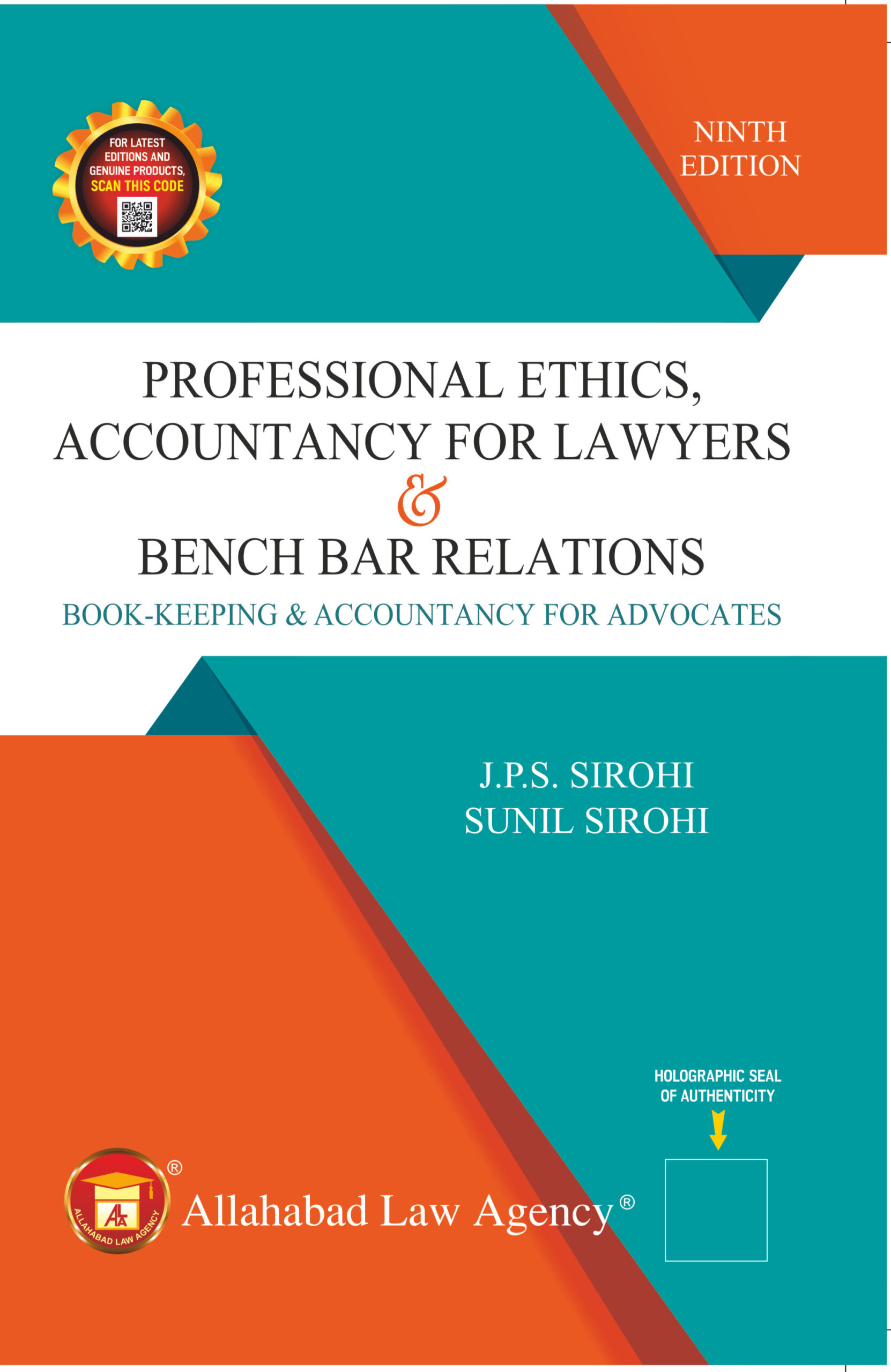

Professional Ethics,Accountancy For Lawyers & Bench Bar Relations by J.P.S Sirohi & Sunil Sirohi is a law textbook published by Allahabad Law Agency.
Written with the needs of law students in mind, it explains the principles and provisions of the subject in a systematic and readable manner, making it a dependable companion for coursework and examination preparation.
Key highlights:
- Systematic, student-friendly treatment of the subject
- Suited to the LL.B. syllabus and competitive examinations
- A trusted Allahabad Law Agency title
What’s Inside — Complete Chapter Map (13 Chapters, 5 Parts + 6 Appendices)
Part I — The Profession and its Regulation (Chapters I–III): the legal profession in India from the Charters of 1726–1774 through the Legal Practitioners Act 1879 and the Indian Bar Councils Act 1926 · admission and enrolment of advocates — eligibility, age, enrolment of persons in other professions and law teachers, BCI Rule 49 before and after its 2001 amendment, disqualification, seniority and the right of pre-audience · State Bar Councils and the Bar Council of India — constitution, functions, elections, accounts, legal education standards and college affiliation, disciplinary powers, appeals to the BCI and the Supreme Court, with the leading judgments.
Part II — Ethics, Misconduct and Bench–Bar Relations (Chapters IV–VII): professional ethics and advocacy — the need for a code, the Standards of Professional Conduct and Etiquette in full (duty to the court, to the client, to the opponent, to colleagues, in imparting training, to render legal aid, and restrictions on other employment), the ban on legal advertising under Rule 36 with comparative US and UK positions, and lawyers’ strikes · punishment for professional or other misconduct — its meaning and ambit, professional negligence, moral turpitude, and 36 decided cases of the Supreme Court, High Courts and the BCI Disciplinary Committee, discussed individually · Bench and Bar as partners in the justice delivery system, judicial accountability and independence.
Part III — Contempt of Court (Chapters VIII–XI): the concept and history of contempt, constitutional provisions and the free-speech balance, defences · civil and criminal contempt — breach of undertaking, scandalising the court, fair criticism, interference with advocates, witnesses and receivers, and apology · contempt by judges, magistrates and lawyers · 19 leading contempt decisions discussed in full, plus the SOP on personal appearance of government officials in court.
Chapter XII — Advocacy: Skill and Tactics: competent representation, issue diagnosis, legal reasoning and research, document analysis, counselling and negotiation · trial advocacy — fundamental rules of pleadings (civil, writ and election petitions), cause of action and amendment under Order VI Rule 17 · evidence and cross-examination, hostile witnesses, confessions and retracted confessions, dying declarations, presumptions, criminal conspiracy, expert and circumstantial evidence. Chapter XIII — Public Interest and Fundamental Rights: PIL and self-restraint, human rights, right to life including passive euthanasia and living wills, speedy trial, arrest and anticipatory bail, and the right to privacy.
Appendices: the Advocates Act, 1961 · the Contempt of Courts Act, 1971 · the BCI Rules for Foreign Lawyers and Foreign Law Firms, 2022 · the BCI Rules · the Advocates’ Welfare Fund Act, 2001 · the Universal Declaration of Human Rights. Part IV covers Book-keeping and Accountancy for Advocates and Part V Bench and Bar Relations.

Reviews
There are no reviews yet.