
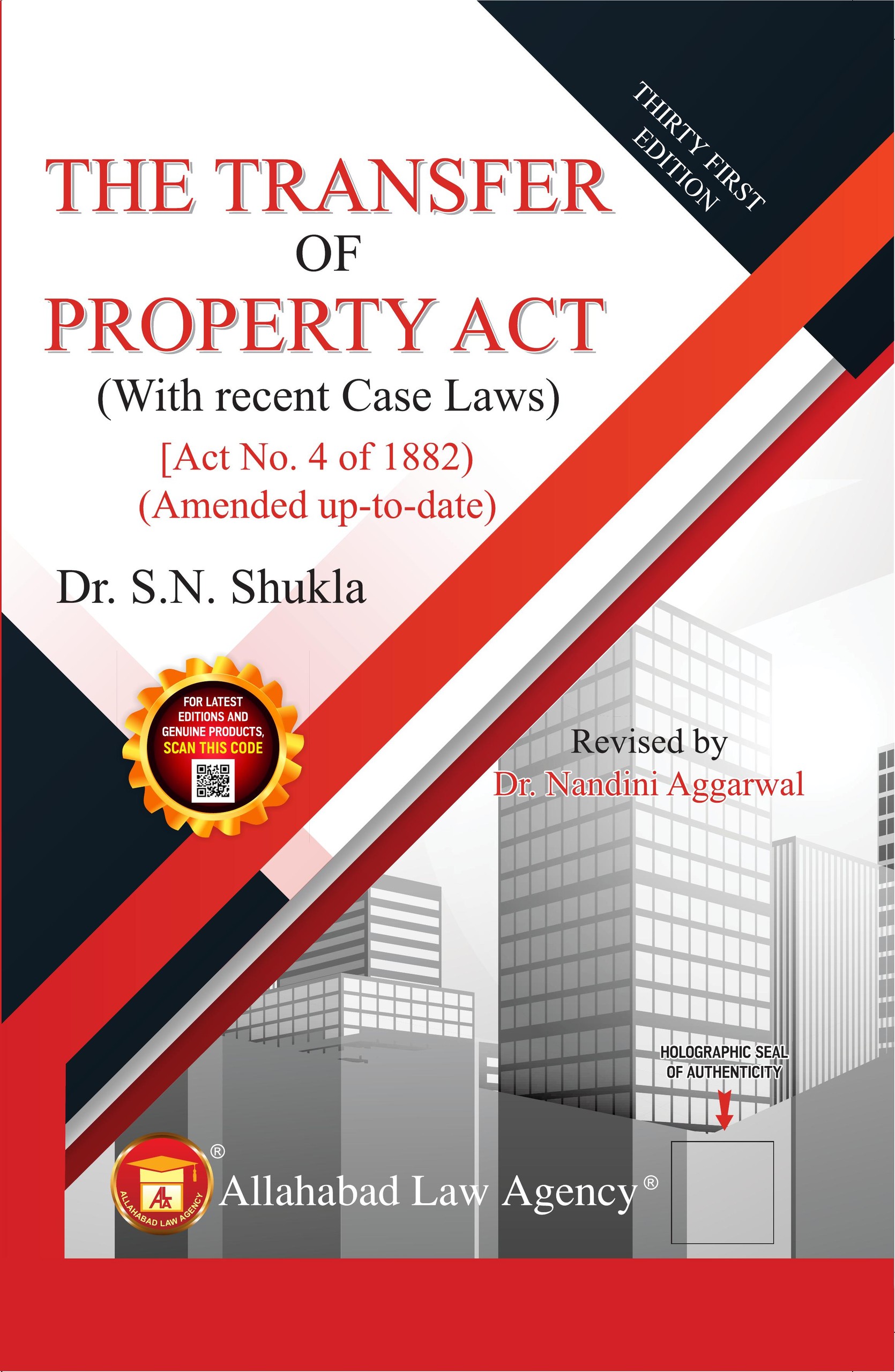

Dr. S.N. Shukla’s The Transfer of Property Act is the concise classroom standard for the property law paper — a name Indian students have relied on for the Transfer of Property Act, 1882 across generations. It covers the general principles of transfer, the doctrines that recur in every examination — the rule against perpetuities, lis pendens, fraudulent transfer, part performance and the doctrine of election — and then the specific transfers: sale, mortgage and its six kinds, charge, lease, exchange, and gift.
Each provision is stated with the leading case law in the compact, exam-ready style that made Shukla a fixture on reading lists. The 2025 edition keeps citations current. A dependable core text for LLB property law and judiciary preliminaries alike.
Allahabad Law Agency — holographic seal on genuine copies.
The Transfer of Property Act by S.N. Shukla is a law textbook published by Allahabad Law Agency.
Written with the needs of law students in mind, it explains the principles and provisions of the subject in a systematic and readable manner, making it a dependable companion for coursework and examination preparation.
Key highlights:
- Systematic, student-friendly treatment of the subject
- Suited to the LL.B. syllabus and competitive examinations
- A trusted Allahabad Law Agency title
What’s Inside — Complete Chapter Map (8 Chapters, Sections 1–137)
A full section-by-section commentary on the Transfer of Property Act, 1882, opening with the Preamble, Introduction and scope of the Act, and closing with the Schedule, a chapter-wise Summary and the text of the Benami Transactions (Prohibition) Act, 1988.
Chapter I — Preliminary (Sections 1–4): short title, extent, repeal, and the interpretation clause. Chapter II — Transfers of Property by Act of Parties (Sections 5–53A): what “transfer of property” means and what may be transferred, persons competent to transfer, oral transfer, conditions restraining alienation, transfer for the benefit of an unborn person, the rule against perpetuity, vested and contingent interests, conditional transfers, election and apportionment — then the immovable-property provisions: transfer by an ostensible owner, feeding the grant by estoppel (Section 43), transfer by one co-owner, priority of rights, improvements by bona fide holders, lis pendens (Section 52), fraudulent transfer (Section 53) and the doctrine of part performance (Section 53A).
Chapter III — Sales of Immovable Property (54–57): sale and contract for sale, rights and liabilities of buyer and seller, marshalling. Chapter IV — Mortgages and Charges (58–104): the six kinds of mortgage, the right of redemption and clogs upon it, rights and liabilities of mortgagor and mortgagee, foreclosure and sale, subrogation, marshalling and contribution, mortgage by deposit of title-deeds, anomalous mortgages and charges. Chapter V — Leases (105–117): lease defined, duration in the absence of a written contract, how leases are made, rights and liabilities of lessor and lessee, determination of lease, waiver and forfeiture, relief against forfeiture, and holding over. Chapter VI — Exchanges (118–121) · Chapter VII — Gifts (122–129): gift defined, acceptance, revocation, onerous gifts, universal donee, donations mortis causa. Chapter VIII — Transfers of Actionable Claims (130–137).
Leading Supreme Court and High Court decisions are woven into the commentary under each section — the standard text for the Property Law paper and for judicial services preparation.
Reviews
There are no reviews yet.