
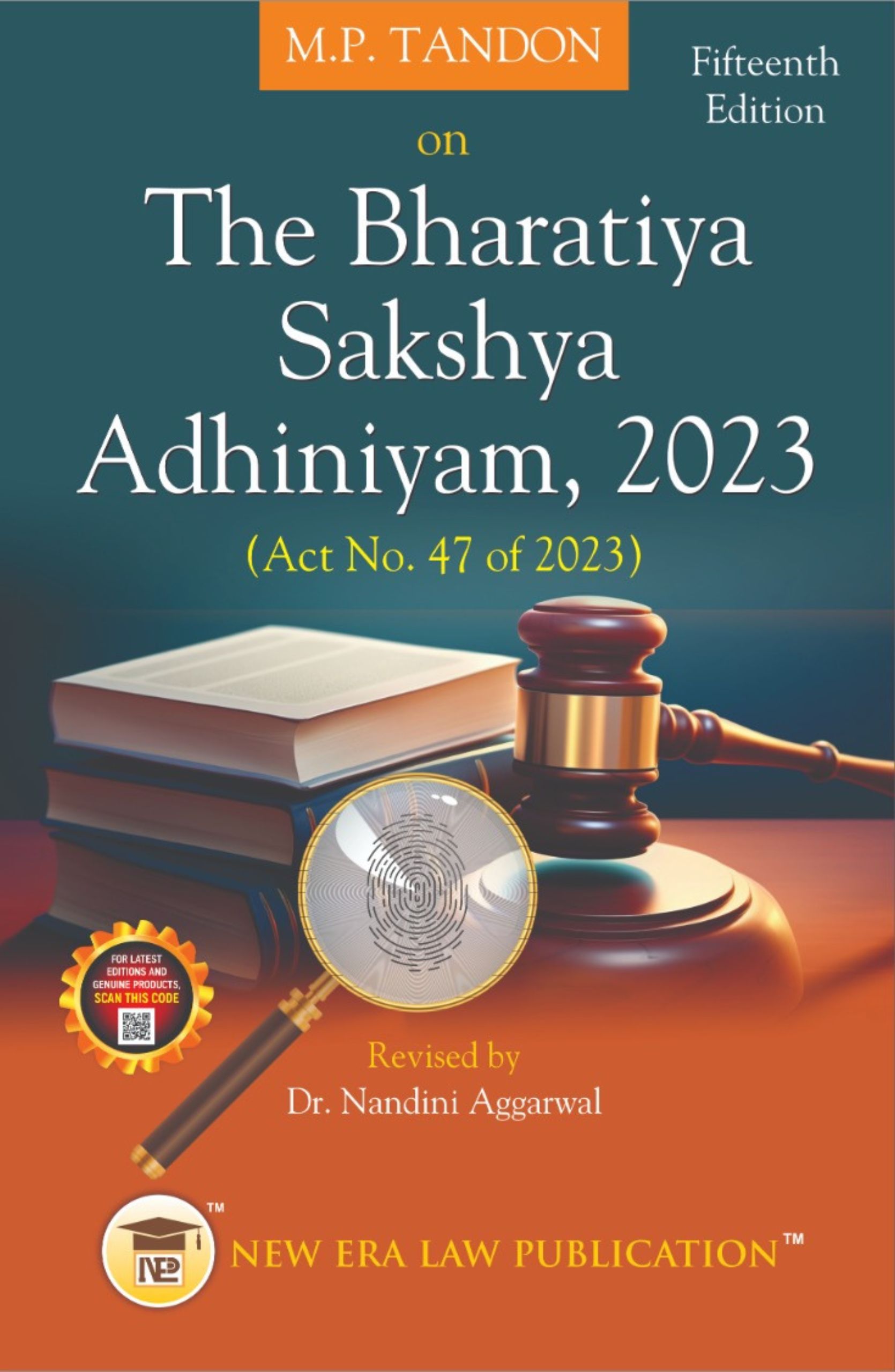
Evidence law has been rewritten — the Indian Evidence Act, 1872 has given way to the Bharatiya Sakshya Adhiniyam, 2023 — and Dr. M.P. Tandon’s commentary, updated with Dr. Nandini, carries his trusted evidence-law tradition into the new code. Every provision is explained in the order students actually study it: relevancy of facts, admissions and confessions, dying declarations, expert opinion, documentary evidence, burden of proof, presumptions, estoppel, and examination of witnesses.
The BSA’s headline change — electronic and digital records elevated to primary evidence — receives detailed treatment, alongside section-by-section mapping to the old 1872 Act so prior study transfers directly. Updated to 2026 with current Supreme Court rulings; suited to LLB evidence papers and judiciary preliminary and mains preparation alike.
Allahabad Law Agency — genuine copies carry the holographic seal.
The Bharatiya Sakshya Adhiniyam,2023 by M.P. Tandon is a law textbook published by Allahabad Law Agency.
Written with the needs of law students in mind, it explains the principles and provisions of the subject in a systematic and readable manner, making it a dependable companion for coursework and examination preparation.
Key highlights:
- Systematic, student-friendly treatment of the subject
- Suited to the LL.B. syllabus and competitive examinations
- A trusted Allahabad Law Agency title
What’s Inside — Complete Coverage Map (170 Sections, 12 Chapters)
A complete section-by-section commentary on the Bharatiya Sakshya Adhiniyam, 2023 — the law of evidence that replaced the Indian Evidence Act, 1872 on 1 July 2024. The book opens with a Correspondence Table and comparison summary against the old Act, a Table of Cases, and an introduction to the law of evidence (modes of proof, presumptions, estoppel, witnesses, quantum of proof).
Part I — Preliminary (Sections 1–2): application, commencement and definitions. Part II — Relevancy of Facts (3–50): facts in issue and relevant facts, res gestae, motive, preparation and conduct, conspiracy, state of mind · Admissions and Confessions (Sections 15–25: confessions caused by inducement or threat, confession to a police officer, discovery of fact) · statements by persons who cannot be called as witnesses, including dying declarations (Section 26) · entries in books of account and public records · judgments when relevant · opinions of experts (Section 39), handwriting, custom and relationship · character evidence.
Part III — On Proof (51–103): facts which need not be proved and judicial notice · oral evidence · documentary evidence — primary and secondary evidence, and the electronic and digital record provisions (Sections 61–63, with the certificate requirement that replaced Section 65B), proof of electronic and digital signatures, public documents and certified copies, and the full set of presumptions as to documents including electronic records · exclusion of oral by documentary evidence.
Part IV — Production and Effect of Evidence (104–170): Burden of Proof (including presumptions as to abetment of suicide by a married woman, dowry death, and absence of consent in rape prosecutions) · Estoppel · Witnesses (competency, privileged communications, spousal communications, accomplice evidence) · Examination of Witnesses (examination-in-chief, cross-examination and re-examination, leading questions, impeaching credit, refreshing memory) · improper admission or rejection of evidence · repeal and savings, with the Schedule.
Every section carries commentary with the leading judgments — the standard text for the Law of Evidence paper under the new criminal laws and for judicial services preparation.

NALINI (verified owner) –
best book
admin (store manager) –
Thanks