
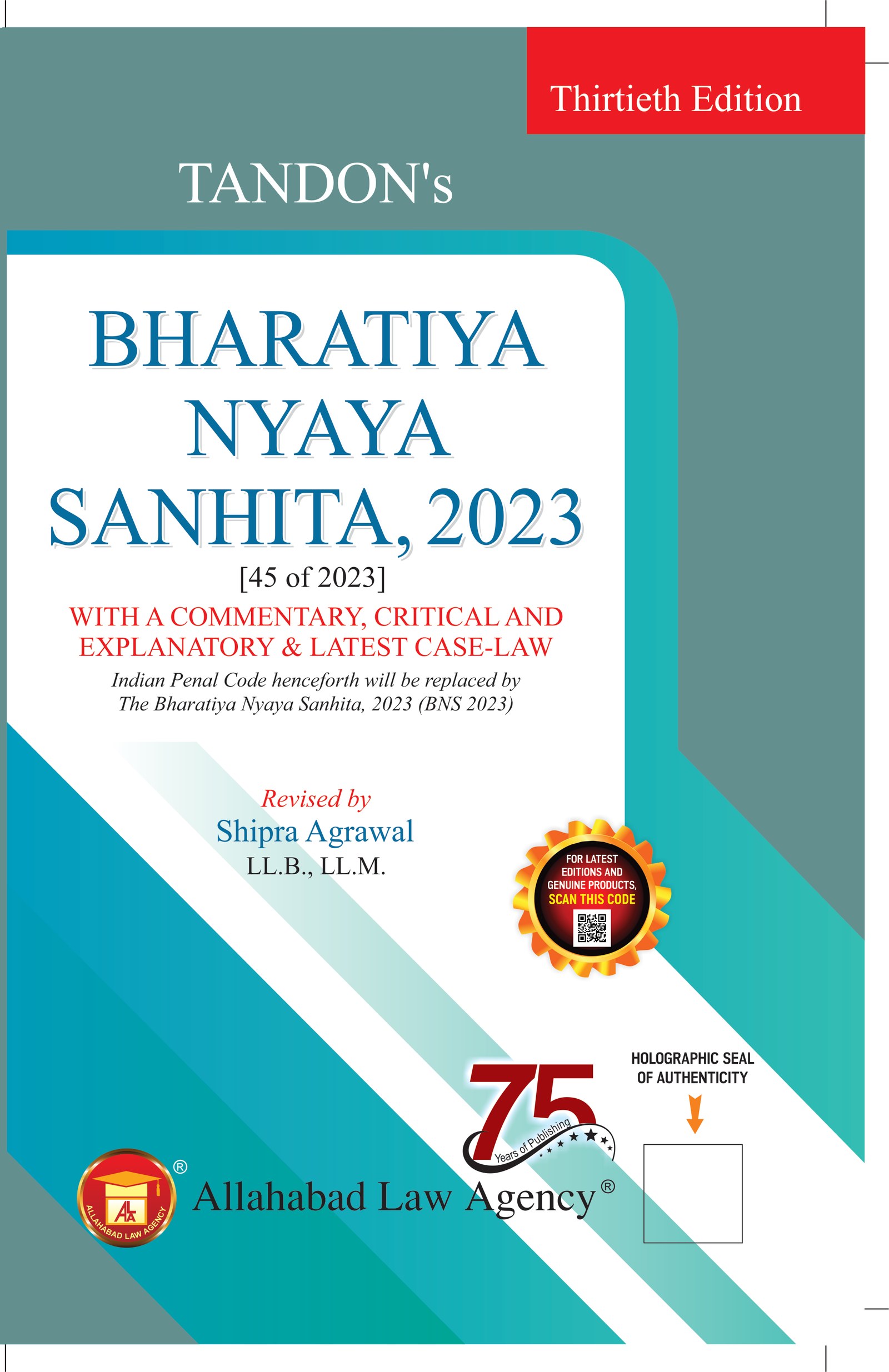
Tandon’s penal law commentary has served thirty editions of Indian law students — first on the IPC, now fully rewritten for the Bharatiya Nyaya Sanhita, 2023. This 30th edition treats the BNS as it is taught: general principles of criminal liability, general exceptions, and then the specific offences — against the human body, property, the State, public tranquillity, and the new-era additions such as organised crime, terrorism, and mob lynching that the BNS codifies for the first time.
Old-to-new comparative tables map every IPC section to its BNS counterpart — indispensable while courts and examiners straddle both codes. Case law is updated with amendments and Supreme Court guidelines current to 2026, with the Statement of Objects and Reasons included.
The prescribed text for BNS papers in LLB and the backbone reference for judicial services mains. Genuine copies carry the ALA holographic seal.
Bharatiya Nyaya Sanhita,2023 by M.P. Tandon is a law textbook published by Allahabad Law Agency.
Written with the needs of law students in mind, it explains the principles and provisions of the subject in a systematic and readable manner, making it a dependable companion for coursework and examination preparation.
Key highlights:
- Systematic, student-friendly treatment of the subject
- Suited to the LL.B. syllabus and competitive examinations
- A trusted Allahabad Law Agency title
What’s Inside — Complete Coverage Map
Tandon’s Bharatiya Nyaya Sanhita, 2023 is a full section-by-section commentary on the new penal code — all 358 sections across 20 chapters — opening with a Comparative Table of IPC 1860 and BNS 2023 sections, a Table of Cases, and a general introduction to criminal law covering the nature and elements of crime, mens rea, theories of punishment and criminology.
The commentary covers, chapter by chapter: Preliminary and Definitions (Sections 1–3) · Punishments (4–13, including community service) · General Exceptions and the Right of Private Defence (14–44) · Abetment, Criminal Conspiracy and Attempt (45–62) · Offences against Women and Children (63–99: rape and its punishments, sexual harassment, voyeurism, stalking, dowry death, cruelty, offences against children) · Offences affecting the Human Body (100–146: culpable homicide and murder, the new offences of organised crime, petty organised crime and terrorist acts, hurt, kidnapping and abduction, trafficking of persons) · Offences against the State (147–158) · Armed Forces (159–168) · Elections (169–177) · Coins, Currency and Stamps (178–188) · Public Tranquillity (189–197: unlawful assembly, rioting) · Public Servants (198–226) · False Evidence and Offences against Public Justice (227–269) · Public Health, Safety and Morals (270–297) · Religion (298–302) · Offences against Property (303–334: theft, the new offence of snatching, extortion, robbery and dacoity, criminal breach of trust, cheating, mischief, criminal trespass) · Documents and Property Marks (335–350) · Criminal Intimidation, Insult and Defamation (351–357) · Repeal and Savings (358).
Every section carries commentary with the leading Supreme Court and High Court decisions, making this the complete textbook and reference for the Criminal Law-I paper under the new criminal laws and for judicial services preparation.


Reviews
There are no reviews yet.