
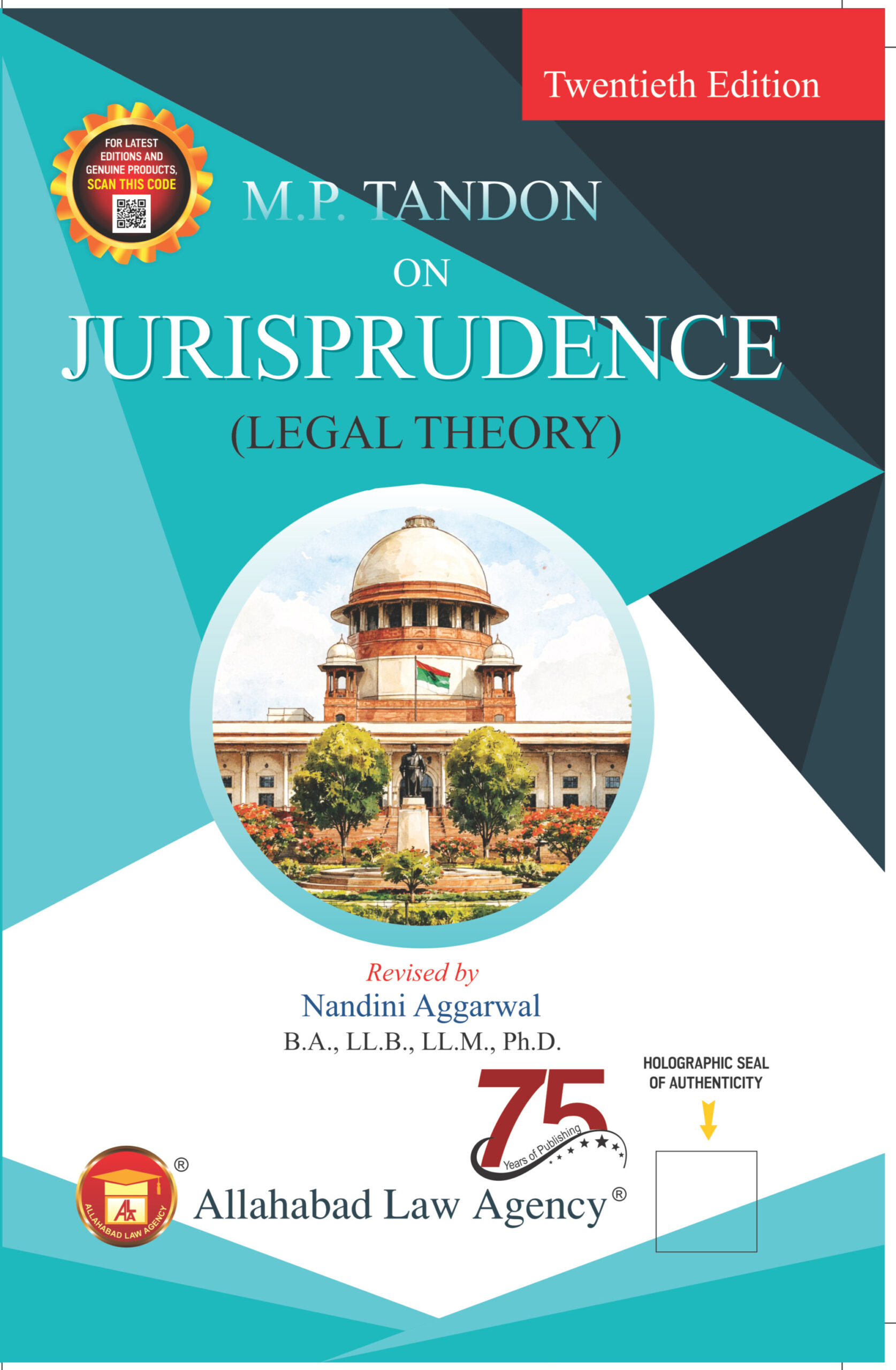
Dr. M.P. Tandon’s Jurisprudence (Legal Theory), updated with Dr. Nandini, is the compact route through the jurisprudence syllabus — built for students who want every examinable topic covered crisply rather than exhaustively. The schools of jurisprudence, the nature and sources of law, precedent and custom, rights, duties and their correlatives, possession and ownership, legal personality, liability and negligence theory, and justice and punishment are each presented in short, structured chapters that map directly onto question papers.
The 2026 edition adds contemporary touchpoints — constitutional morality and the modern Indian Supreme Court’s engagement with legal theory — that examiners increasingly reward. Well suited to LLB semester papers and rapid judiciary revision.
Allahabad Law Agency — genuine copies carry the holographic seal.
Jurisprudence (Legal Theory) by M.P. Tandon is a law textbook published by Allahabad Law Agency.
Written with the needs of law students in mind, it explains the principles and provisions of the subject in a systematic and readable manner, making it a dependable companion for coursework and examination preparation.
Key highlights:
- Systematic, student-friendly treatment of the subject
- Suited to the LL.B. syllabus and competitive examinations
- A trusted Allahabad Law Agency title
What’s Inside — Complete Chapter Map (30 Chapters)
Legal theory and the schools (Chapters 1–3): the nature and scope of jurisprudence, its kinds and divisions, utilitarianism · the Natural Law School from Greece and the Stoics through Aquinas and Grotius · the Historical School (Savigny and Maine) · the Imperative School — Austin’s command theory, Hobbes, Holland, Hart’s concept of law and Kelsen’s pure theory · Mechanical Jurisprudence · Sociological Jurisprudence and Roscoe Pound · Legal Realism and Jerome Frank · Critical Legal Studies · judicial legislation, activism and discretion.
Law and its sources (Chapters 4–10): the nature of law, law and morals, kinds of law · general and special law, conventional and autonomic law, international law and whether it is true law, common law, constitutional and administrative law, delegated legislation · sources of law · Custom (requisites of a valid custom, legal and conventional custom, custom and prescription) · Legislation (types, how a Bill becomes law, codification in England and India) · Judicial Precedent (ratio decidendi and obiter dicta, per incuriam, stare decisis and departures from it, the rules laid down by the Supreme Court of India) · Equity with the twelve classical maxims.
Core jurisprudential concepts (Chapters 11–22): judicial process and public policy · the Administration of Justice (natural justice, civil and criminal justice, and the theories of punishment — deterrent, preventive, retributive, denunciatory and reformative) · State and Sovereignty · Legal Rights (Hohfeldian analysis of rights, liberties, powers and immunities) · Kinds of Rights (rights in rem and in personam, proprietary and personal, vested and contingent) · Ownership · Possession (corpus and animus, Savigny’s theory, mediate and immediate possession) · Persons (legal personality, corporations, lifting the corporate veil, theories of corporate personality) · Titles · Liability (penal and remedial, mens rea, intention and motive) · Property · Obligations.
Applied and contemporary topics (Chapters 23–30): Intellectual Property (Copyright, Patents, Trade Marks, Designs and the international conventions) · Statutory Interpretation including the Mimansa rules of ancient India · welfare legislation and its interpretation · Public Interest Litigation — evolution, achievements and misuse · Legal Aid · Lok Adalats · Law and Social Change · Human Rights (the UDHR, covenants, Fundamental Rights and Directive Principles, the Human Rights Commission).
The standard text for the Jurisprudence and Legal Theory paper in LL.B. and LL.M. courses, and a core subject for judicial services and competitive examinations.


Reviews
There are no reviews yet.