
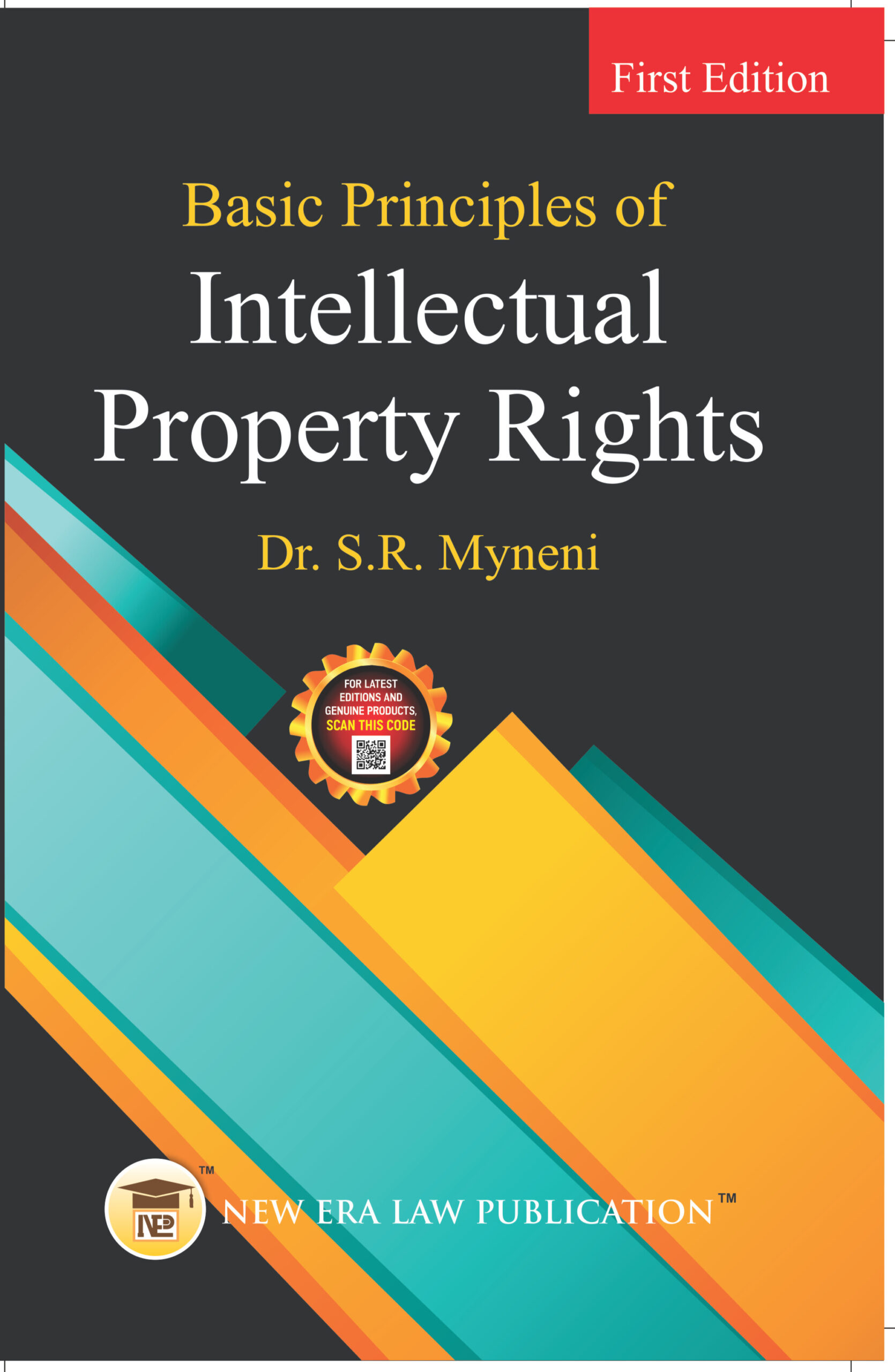
Dr. S.R. Myneni’s Basic Principles of Intellectual Property Rights is the foundations-first route into IPR — built for students meeting the subject fresh and for LLM/NET candidates who need the conceptual scaffolding before the case law. It opens with the philosophy and economics of intellectual property, then covers each regime in turn — copyright, patents, trademarks, designs, geographical indications, trade secrets and plant varieties — explaining what each protects, why, for how long, and where the boundaries between them lie.
International architecture — the Paris and Berne Conventions, TRIPS, WIPO — gets clear treatment, so India’s statutes are understood inside their global obligations. Part of Myneni’s extensive IPR series, this is the volume to read first. 2025 edition.
Allahabad Law Agency — genuine copies carry the holographic seal.
Basic Principles of Intellectual Property Rights by S.R. Myneni is a law textbook published by Allahabad Law Agency.
Written with the needs of law students in mind, it explains the principles and provisions of the subject in a systematic and readable manner, making it a dependable companion for coursework and examination preparation.
Key highlights:
- Systematic, student-friendly treatment of the subject
- Suited to the LL.B. syllabus and competitive examinations
- A trusted Allahabad Law Agency title
What’s Inside — Complete Coverage Map (5 Units)
Unit I — Introduction to Intellectual Property Rights (21 chapters): the changing notion of property and how the Supreme Court has read it · tangible and intangible property · the eleven characteristics of intellectual property — intangibility, exclusivity, territoriality, time-bound protection, mandatory public disclosure, its double role in private and public interest, transferability and protection against misappropriation · how intellectual property differs from physical commodities · intangible assets and their valuation and financing · new dimensions — the digital revolution, biotechnology and patenting life, traditional knowledge, domain names and the UDRP, business-method and software patents · valuing IP by the cost, market and income methods and the challenges of each · the definition, nature, scope, need and criticism of IPR · the seven kinds of intellectual property — patents, copyright, trade and service marks, industrial designs, geographical indications, layout designs of integrated circuits and trade secrets · the history of IPR worldwide and in India for patents, copyright, trademarks and designs · emerging trends — biotechnology, computer programs, artificial intelligence and blockchain · the rationale for protecting each kind of right · the constitutional aspects of intellectual property, its relationship with the right to education and the right to health, and whether IPR are fundamental rights, with the landmark judgments · IPR and human rights — the overlap with the Universal Declaration and the ICESCR, the tension with the right to health and the right to food, and the resolution of the conflict · and the balancing of the rights of the IPR holder against those of society, dynamic competition and economic development.
Unit II — Justifying Theories of Intellectual Property (21 chapters): the philosophical, economic and personality-based justifications · Bentham’s utility theory · Locke’s labour theory · the Hegelian personality theory · natural rights theory with its defences and its failures · social planning theory · social contract theory through Hobbes, Locke and Rousseau · economic theory · Schumpeterian growth and innovation theory · reward, incentive and prospect theories · the Marxian and Gandhian views of private and intellectual property, including Gandhi’s trusteeship · free riding · the eleven theories of patent rights and the economics of patents · the theories of copyright (fair, personality, welfare, culture and consequentialist) · the theories of trademark (search costs, quality assurance, likelihood of confusion, free-riding and consumer decision-making) · and IPR against individual interests — the privacy and freedom-of-expression arguments.
Unit III — Intellectual Property and Competition (9 chapters): the theoretical basis of competition including the neo-classical synthesis and the Chicago School · the Competition Act, 2002 — objectives, features, key concepts and regulatory framework · the interface between competition law and IPR through six theoretical lenses · the points of conflict — abuse of dominant position, refusal to license, excessive pricing and tying agreements, and Section 3(5)(i) · TRIPS flexibilities (Articles 8, 40 and 31K) and their impact · abuse of dominance under Section 4 with the prohibited practices, investigation, penalties and the landmark Indian cases · combinations and how they affect competition · the doctrine of exhaustion — international, national and regional — and parallel imports under the Trade Marks, Patents and Copyright Acts · and the modern flashpoints: cartelisation, standard essential patents, tie-in agreements, pay-for-delay settlements, patent thickets and non-price predation.
Unit IV — Conventions, Agreements and Treaties (14 chapters): the full article-by-article text of the Paris Convention (1883), the Patent Cooperation Treaty (1970), the Hague Agreement on industrial designs, the Madrid Agreement on international registration of marks, the Trade Mark Law Treaty (1994), the Madrid Agreement on false indications of source, the Lisbon Agreement on appellations of origin with its Regulations, the Berne Convention (1971) with the developing-country Appendix, the Universal Copyright Convention, the WIPO Copyright Treaty (1996), the WIPO Convention (1967), and the TRIPS Agreement (1995) in full — general principles, the standards for each right, enforcement, provisional and border measures, criminal procedures, dispute settlement and transitional arrangements · closing with the practical implications of TRIPS implementation for developing countries and the problem of TRIPS-Plus obligations.
Unit V — Intellectual Property Rights in India (11 chapters): the National IPR Policy, 2016 — all seven objectives from awareness and generation of IPR through the legal framework, administration, commercialisation, enforcement and human capital development, with the implementation record · copyright and related rights — subject matter, the rights in each kind of work, ownership, limitations, piracy and remedies, with Indian case law · trademarks — requirements and procedure for registration, opposition, offences and penalties, with the leading cases · geographical indications — the full registration procedure, rights conferred, infringement and remedies, with the Pochampally Ikat, Darjeeling Tea, Scotch and Basmati case studies · designs — registration procedure and twelve landmark decisions on novelty and the copyright-design interface · semiconductor integrated circuits layout-design · the Biological Diversity Act, 2002 · patents — patentable and non-patentable inventions, novelty, inventive step and industrial applicability, who may apply, the types of application, the rights of a patentee, infringement and the offences, with Indian case law · the Protection of Plant Varieties and Farmers’ Rights regime · and trade secrets — criteria, rights, enforcement, precautionary measures and how they differ from patents.

Reviews
There are no reviews yet.