
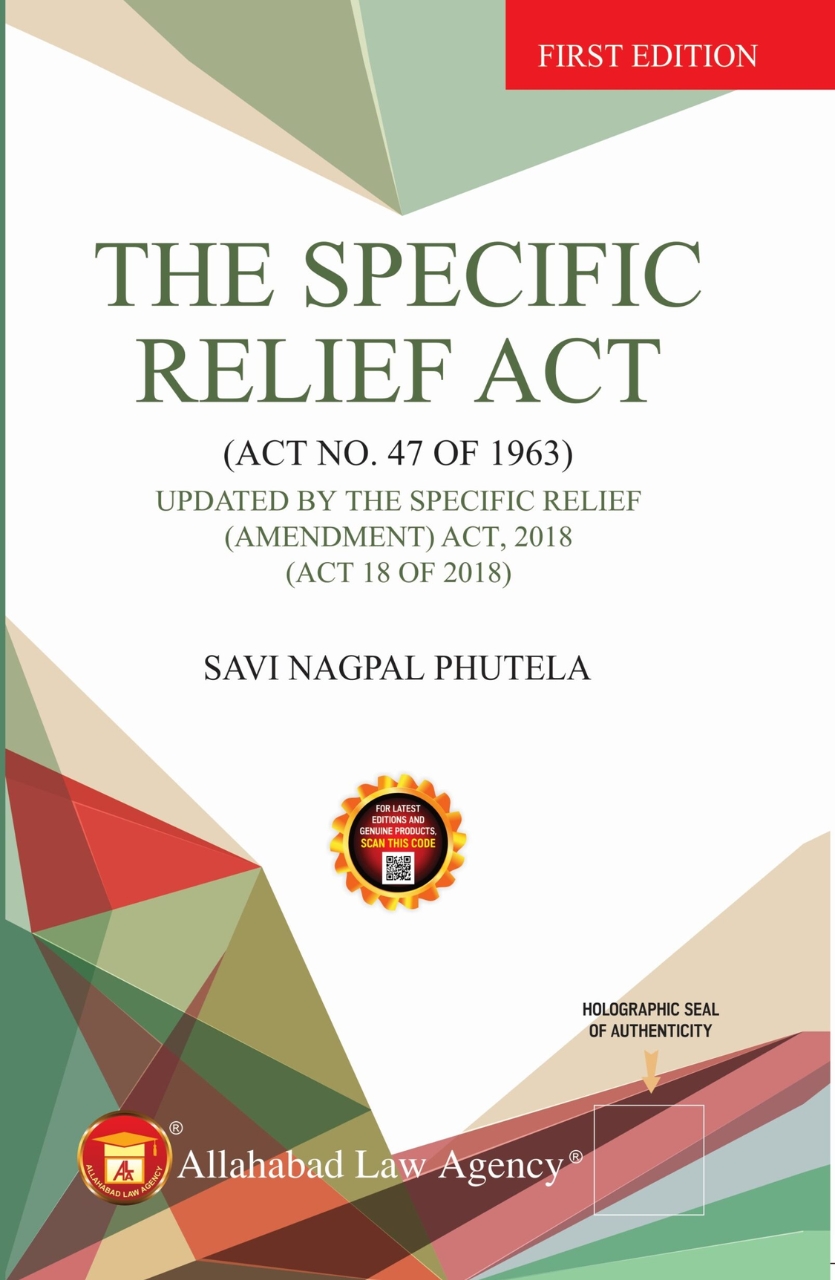
The Specific Relief Act,1963 by Savi Nagpal Phutela is a law textbook published by Allahabad Law Agency.
Written with the needs of law students in mind, it explains the principles and provisions of the subject in a systematic and readable manner, making it a dependable companion for coursework and examination preparation.
Key highlights:
- Systematic, student-friendly treatment of the subject
- Suited to the LL.B. syllabus and competitive examinations
- A trusted Allahabad Law Agency title
What’s Inside — Complete Chapter Map (42 Sections, 4 Parts)
A section-by-section commentary on the Specific Relief Act, 1963 as amended in 2018 — opening with a full treatment of what the Specific Relief (Amendment) Act, 2017 changed with effect from 2018: the shift from a discretionary remedy to an enforceable right, the retrospective-versus-prospective debate, mutuality of obligation, and the essentials a plaintiff must plead and prove. It also collects sixteen key Supreme Court holdings on specific performance — readiness and willingness, proof of means to pay, hardship not pleaded in the written statement, efflux of time and price escalation, minors, joint promisees and co-parceners.
Part I — Preliminary (Sections 1-4): extent, definitions, savings, and specific relief only for enforcing individual civil rights. Part II — Specific Relief: Recovering Possession of Property (Sections 5-8, immovable and movable) · Specific Performance of Contracts (Sections 9-25) — defences, contracts that can and cannot be specifically enforced under the substituted Section 14, substituted performance under Section 20, the personal bars under Section 16, relief against subsequent transferees under Section 19, the new infrastructure-project provisions and Special Courts (Sections 20A-20C), and compensation under Section 21 · Rectification of Instruments (Section 26) · Rescission of Contracts (27-30) · Cancellation of Instruments (31-33) · Declaratory Decrees (34-35).
Part IV — Preventive Relief (Sections 36-42): types of injunctions, temporary and perpetual injunctions, mandatory injunctions (Section 39), damages in lieu of or in addition to an injunction, when an injunction must be refused, and injunctions to enforce negative agreements — closing with practice notes on readiness and willingness, unblemished conduct, and who may claim specific performance.
Includes a Table of Cases and section-wise questions — for the Specific Relief paper, for civil practice, and for judicial services preparation.
Reviews
There are no reviews yet.