
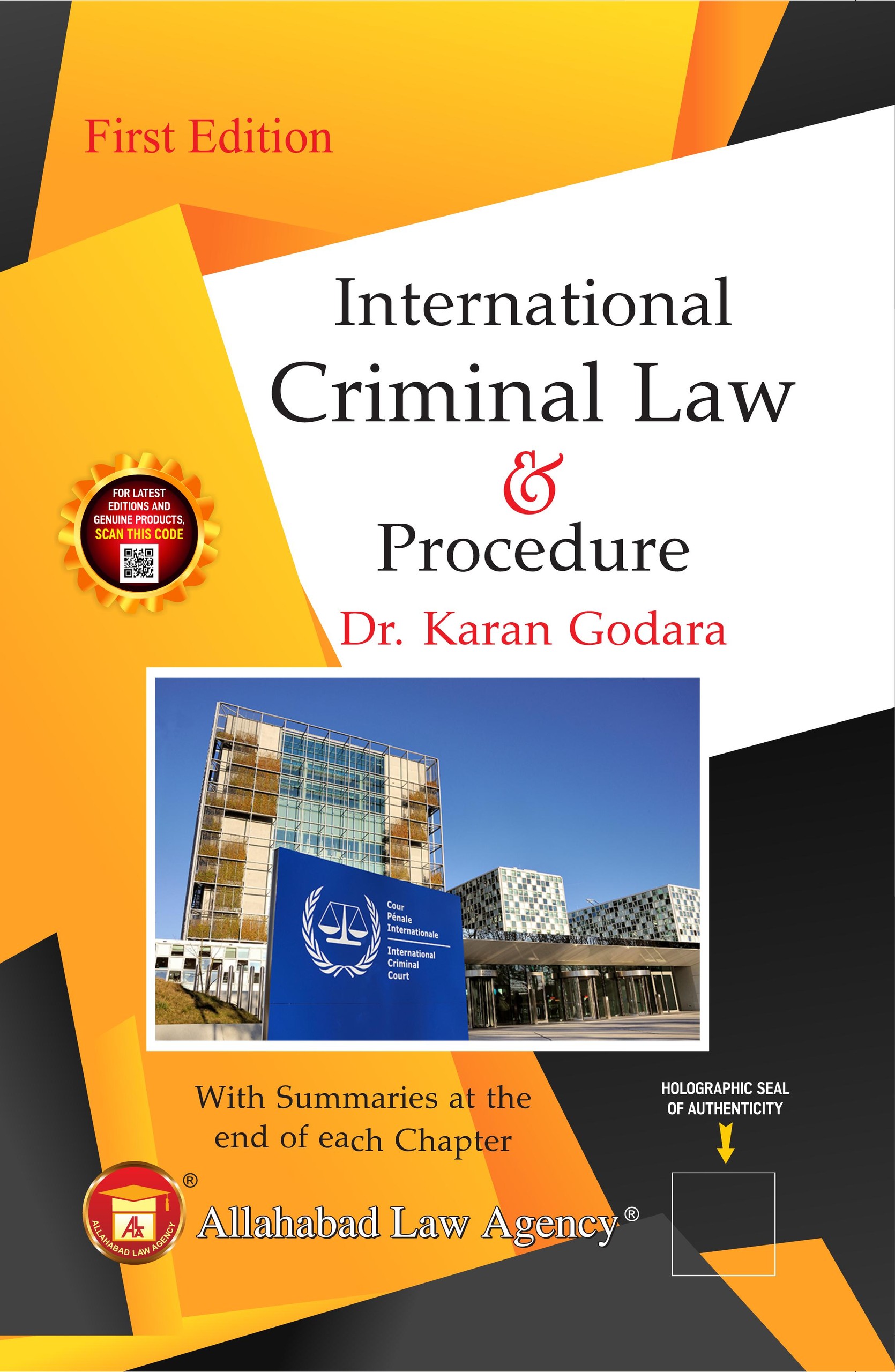
International Criminal Law & procedure :Dr. Karan Godara is a law textbook published by Allahabad Law Agency.
Written with the needs of law students in mind, it explains the principles and provisions of the subject in a systematic and readable manner, making it a dependable companion for coursework and examination preparation.
Key highlights:
- Systematic, student-friendly treatment of the subject
- Suited to the LL.B. syllabus and competitive examinations
- A trusted Allahabad Law Agency title
What’s Inside — Complete Chapter Map (15 Chapters + 3 Appendices)
With a Foreword by Prof. Dr. Shruti Bedi, a List of Cases, and a “Chapter in a Nutshell” summary closing every chapter.
Chapters 1–3 — Foundations: the concept, objectives and key features of international criminal law, and how it differs from transnational criminal law · its relationship with international humanitarian law and human rights law, and the points of divergence · international criminal procedure and its hybrid mix of adversarial and inquisitorial systems at the ICC · the sources of international criminal law — treaties, customary international law, general principles, and the writings of jurists — with the law applicable to the ICC under Article 21 · the five types of criminal jurisdiction — territorial, active and passive nationality, protective, and universal jurisdiction including its permissive or mandatory character, its relationship with jus cogens crimes and the Eichmann prosecution · and immunities, including the harmonious construction of Articles 27(2) and 98(1) of the Rome Statute · then the key concepts — international versus transnational crimes, individual criminal responsibility, corporate and State responsibility, jus cogens and erga omnes obligations, ne bis in idem, nullum crimen sine lege, statutes of limitation, and the principle of complementarity · and the physical and mental elements — actus reus and the shades of mens rea (dolus directus, dolus specialis, dolus eventualis and negligence) under Article 30.
Chapter 4 — From Nuremberg to The Hague: the pre-Nuremberg phase including the Treaty of Versailles and the Leipzig trials · the Nuremberg (IMT) and Tokyo (IMTFE) trials with their charters and criticisms · Control Council Law No. 10 · the Cold War period and the Eichmann case · the ICTY and ICTR — the background to each conflict, the statutes, the crimes within jurisdiction and the functioning of each tribunal · the International Criminal Court — the road to Rome, the Kampala Review Conference, the structure of the Statute and a critical appraisal · the hybrid or internationalised courts — the Special Court for Sierra Leone, the Special Tribunal for Lebanon and the Extraordinary Chambers in Cambodia · and Asia and international criminal law, including international crimes under Indian law and the Bangladesh tribunal.
Chapters 5–8 — The core crimes: Genocide — Raphael Lemkin’s contribution, the protected groups and why only four, the five categories of prohibited conduct, the dolus specialis, “in whole or in part”, and whether ethnic cleansing amounts to genocide · Crimes against Humanity — from the Martens Clause to the Nuremberg Charter, the elimination of the armed-conflict nexus, the essential ingredients (a widespread or systematic attack directed against a civilian population in pursuance of a State or organisational policy, with the perpetrator’s knowledge), and each underlying offence from murder and extermination through enslavement, deportation, torture, the sexual crimes, persecution, enforced disappearance and apartheid to the residuary clause · War Crimes — the origins of international humanitarian law, jus in bello versus jus ad bellum, the distinction between international and non-international armed conflicts and its progressive blurring, the effective control and overall control tests for proxy warfare, and the war crimes punishable in each type of conflict · and the Crime of Aggression — its birth, the UN Charter, adoption at Kampala, and its elements as a leadership crime.
Chapters 9–11 — Transnational law, participation and defences: transnational criminal law — terrorism, drug trafficking, organised crime, counterfeiting, money laundering, cyber-crimes, environmental crimes and maritime piracy, the UN Convention against Transnational Organized Crime with its three Protocols, Interpol, and extradition and mutual legal assistance · the modes of participation — direct, co- and indirect perpetration, ordering, soliciting, aiding and abetting, joint criminal enterprise and common purpose liability, direct and public incitement to genocide, attempt, and command or superior responsibility · and the defences — age, mental incapacity, intoxication, self-defence, duress, mistake of fact and of law, and superior orders, with the burden of proof.
Chapters 12–15 — The ICC in practice: the Court’s establishment and its subject-matter, territorial, personal and temporal jurisdiction · the trigger mechanisms — State-party referral, the Prosecutor proprio motu and Security Council referral, with the separate regime for aggression · deferrals and admissibility challenges under Articles 17, 18 and 19 · the organs of the Court · all seventeen situations before the ICC, from the Democratic Republic of Congo and Uganda through Darfur, Kenya, Libya, Palestine, Bangladesh/Myanmar and Afghanistan to Ukraine · the stages of proceedings from investigation and confirmation of charges through trial, penalties and the Trust Fund to appeal and revision · victims — their definition, right to participation and right to reparations · and State cooperation, enforcement of sentences, the Assembly of States Parties, reservations, amendments and withdrawals.
Three appendices reproduce the Rome Statute of the International Criminal Court in full, the Elements of Crimes, and the Rules of Procedure and Evidence — making the book a self-contained working text as well as a commentary.
Nandan Nagpal –
Dr. Karan Godara’s book on international criminal law offers a timely and comprehensive exploration of key issues like genocide, war crimes, and crimes against humanity. It effectively traces the evolution of the field from post-World War II to current global conflicts, including Ukraine and Palestine. The inclusion of chapter summaries makes it a practical resource for students and legal professionals alike. Clear, concise, and insightful, it’s a valuable guide for understanding the complexities of international criminal law.
Karan Singh –
A comprehensive and easy to read book. Worth buying
Surbhi –
This is the best book on international criminal law in the market. Love that it is easy to read and understand! Kudos to the author.
Angad singh –
A very well written book, extremely easy to read and comprehend. Dr Karan Godara thank you for sharing insights with this wonderful book.
Chinar –
A thought provoking read for anyone interested in the subject of international law.
Manan Arora –
I bought this book quite worth buying it very easy to understand
Manan Arora –
I bought this book quite worth buying it very easy to understand must invest in this gold book(Done and Dusted)
Nikhil Dogra –
Worth buying. Easy to read.