
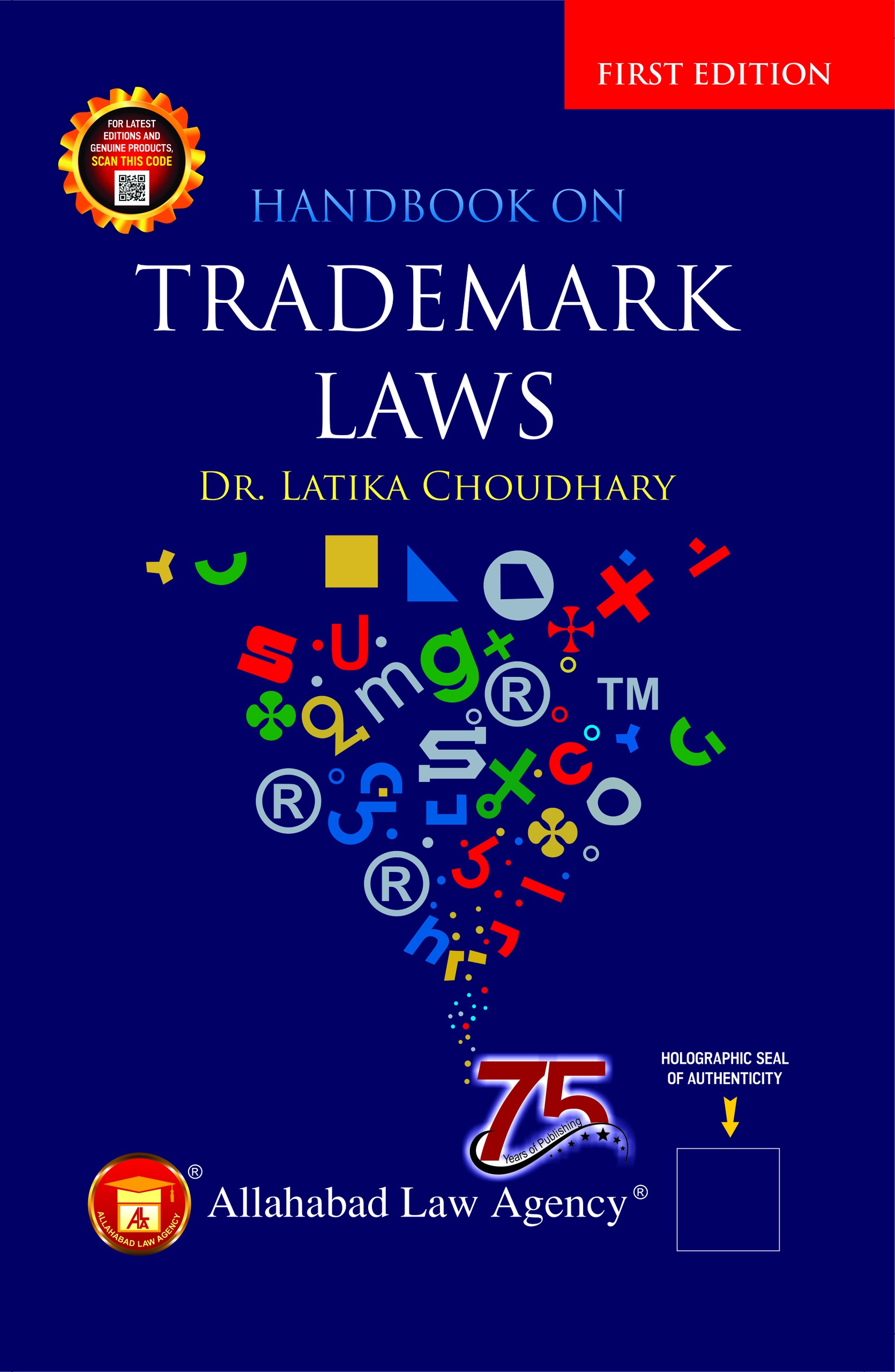
Dr. Latika Choudhary’s Handbook on Trademark Laws is a compact, practice-oriented guide to Indian trademark law — at ₹195, the accessible entry point for students, young practitioners and businesses alike. It covers what a trademark is and the functions it serves, registrable and non-registrable marks, the registration procedure from search to opposition, absolute and relative grounds for refusal, infringement versus the common-law action of passing off, well-known marks, assignment and licensing, and offences and remedies under the Trade Marks Act, 1999.
Written to be usable rather than exhaustive, with the leading cases stated briefly, it works as a quick reference for the IPR paper and as a first orientation for anyone protecting a brand. 2026 edition.
Allahabad Law Agency — genuine copies carry the holographic seal.
Handbook On Trademark Laws by Dr. Latika Choudhary is a law textbook published by Allahabad Law Agency.
Written with the needs of law students in mind, it explains the principles and provisions of the subject in a systematic and readable manner, making it a dependable companion for coursework and examination preparation.
Key highlights:
- Systematic, student-friendly treatment of the subject
- Suited to the LL.B. syllabus and competitive examinations
- A trusted Allahabad Law Agency title
What’s Inside — Complete Chapter Map (10 Chapters, each with a Question Bank)
Every chapter closes with a Question Bank, making this a teaching text as much as a reference.
Chapter 1 — The Journey of Trademarks: why marks matter to identity, trust and legacy · their origins in ancient civilisation — clay seals and merchant marks, Roman potters’ marks, and the guild marks of medieval Europe · marks beyond commerce as symbols of culture and politics, and where religious symbols meet trademark law · and a set of fascinating cases — protecting a colour, the evolution of an icon, and unusual marks made of smells, sounds and three-dimensional shapes.
Chapter 2 — International Instruments: the international IPR regime — WIPO, the WTO and the TRIPS Agreement, and the shift from GATT to WTO · trademarks in a globalised economy and why international protection matters · the Madrid System and its benefits · and the Nice Agreement on the international classification of goods and services.
Chapter 3 — All About Trademarks: the objectives of trademark law and its historical background in India · meaning and definition · conventional and non-conventional marks and their kinds · the four functions of a mark — indicating origin, distinguishing goods, indicating quality and serving as a marketing tool · and domain names — how trademark law applies to them, how the two differ, and the UDRP with its key elements, procedure, advantages and limitations.
Chapter 4 — Conditions of Registration: the absolute grounds of refusal — distinctiveness with the judicial precedents and the types of marks, descriptive words and whether they can ever be registered, words with different meanings in different parts of India, invented words, geographical names and when they acquire distinctiveness, and publici juris terms · the relative grounds — similarity of goods and services, identity with a well-known trademark and the criteria India applies · registration on honest concurrent use and the factors courts weigh · and registration of parts of a mark.
Chapter 5 — Procedure for Registration: who may apply, acceptance or refusal, correction and amendment, withdrawal, advertisement, opposition, registration and the register, abandonment, joint ownership, duration, renewal, restoration and removal of a mark and the effect of removal.
Chapter 6 — Effect of Registration, Infringement and Passing Off: the common-law action for passing off and its elements · rights conferred by registration under Section 28, exclusive use, and the right to assign and licence · infringement — deceptive similarity (with the stricter standard for medicinal products), deceptive similarity in domain names, similarity of goods and services, dilution, infringement by advertisement and disparagement · acts that do not constitute infringement — acquiescence, exhaustion of rights, prior use and laches · the difference between infringement and passing off · registration as prima facie evidence of validity · and ownership of goodwill in a mark.
Chapter 7 — Assignment and Transmission: assignment and transmission compared across five dimensions — nature of transfer, the requirement of a deed, inclusion of goodwill, the role of registration and the strategic implications · the statutory restrictions · assignment without goodwill · and registration of an assignment.
Chapter 8 — Offences, Penalties and Procedure: falsely applying a trademark, the burden of proof in trademark offences, the penalties and punishment for applying a false mark and for selling goods bearing one, and the other offences with their procedures.
Chapter 9 — Jurisdiction and Remedies: where a suit must be instituted, the special jurisdiction available to trademark owners, jurisdiction in passing-off actions, the interplay with the High Courts’ original jurisdiction, and the case law on avoiding forum shopping · injunctions — interim, permanent and quia timet, with Anton Piller and Mareva ancillary orders · damages and accounts of profits, exemplary and additional damages · and groundless threats of legal proceedings with the reliefs available in a threats action.
Chapter 10 — Global Emerging Issues: trademark trafficking · online brand protection and cybersquatting · parallel importation and trademark exhaustion · and the protection and enforcement of unconventional marks — their types, the criteria for legal recognition, and the practical enforcement challenges.
Reviews
There are no reviews yet.