
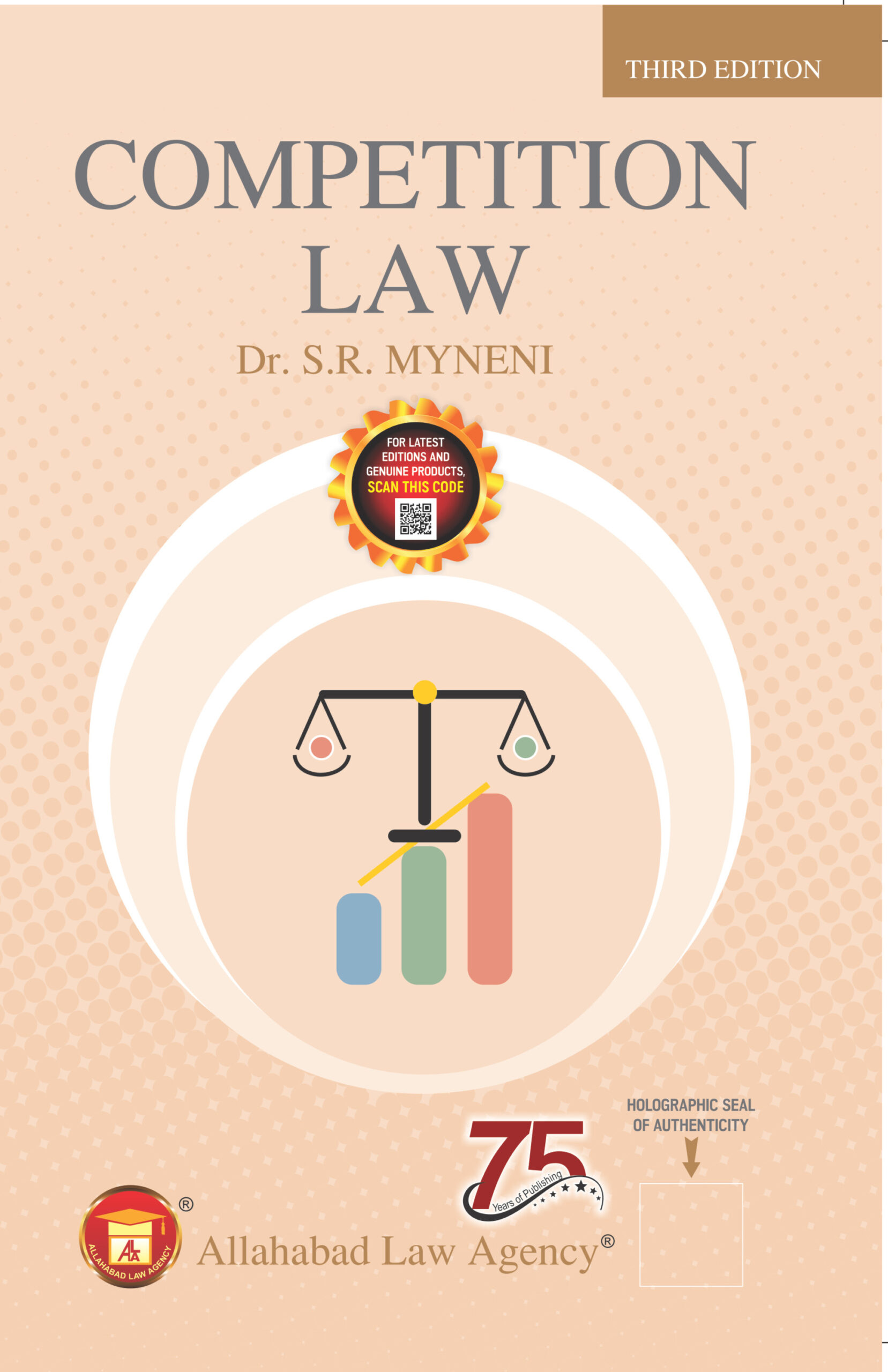
Dr. S.R. Myneni’s Competition Law is the dedicated text on the Competition Act, 2002 — a subject that has moved from niche to mainstream as the CCI’s enforcement grows and the paper appears across LLB and LLM programmes. It covers the objectives and scheme of the Act, anti-competitive agreements (horizontal and vertical, cartels and the leniency regime), abuse of dominant position, the regulation of combinations (mergers and acquisitions), and the institutional framework of the CCI and the appellate tribunal, with the enforcement and penalty provisions.
Leading CCI orders and appellate decisions are woven in, alongside the comparative US and EU antitrust background that gives the subject depth. The 2025 edition reflects recent amendments including the 2023 changes. A focused, current text for competition law papers.
Allahabad Law Agency — genuine copies carry the holographic seal.
Competition Law by Dr. S.R. Myneni is a law textbook published by Allahabad Law Agency.
Written with the needs of law students in mind, it explains the principles and provisions of the subject in a systematic and readable manner, making it a dependable companion for coursework and examination preparation.
Key highlights:
- Systematic, student-friendly treatment of the subject
- Suited to the LL.B. syllabus and competitive examinations
- A trusted Allahabad Law Agency title
What’s Inside — Complete Coverage Map (5 Units)
Unit I — Evolution of Competition Law (8 chapters): the meaning, scope, principles and objectives of competition law — welfare, efficiency and free and fair competition — and why it matters (lower prices, better quality, more choice, innovation, stronger competitors in global markets) · its history from Roman legislation and the Middle Ages through early European law to modern US antitrust and EU law · the economic theories — the classical perspective, the neo-classical synthesis, the Chicago School and Robert Bork, collusion and cartels, dominance and monopoly, and the theories of justice · competition law policy and its interface with other government economic policies · the Draft National Competition Policy, 2011 in full — the need for and premise of a competition policy, its principles, central, State and sub-State initiatives, oversight measures and coordination between the CCI and sectoral regulators · the concentration of economic power in India from 1948 to 1969, including the Industries (Development and Regulation) Act 1951, the Industrial Policy Resolution 1956, the Mahalanobis Committee, the Monopolies Inquiry Commission 1964, the Hazari Report and the Dutt Committee · the MRTP Act, 1969 reproduced section by section (Sections 1–67) with monopolistic, restrictive and unfair trade practices, the Commission’s powers, resale price maintenance and all the penalty provisions · and the transition from MRTP to the Competition Act through the industrial policies of 1973, 1977, 1985 and 1991 and the Raghavan Committee Report.
Unit II — The Competition Act, 2002 (6 chapters): the main features and objectives, and a clause-by-clause comparison of the MRTP Act 1969 with the Competition Act 2002 · extent and definitions (Sections 1–2) · prohibition of anti-competitive agreements (Section 3) — how appreciable adverse effect on competition is determined, horizontal and vertical agreements, and the IPR exemption under Section 3(5) · a dedicated chapter on competition law and intellectual property rights — the objectives of each, competition and patents, TRIPS, compulsory licensing, the statutory framework and the points of conflict · prohibition of abuse of dominant position (Section 4) — what dominance implies, how it is examined, the relevant market, and what amounts to abusive conduct · and regulation of combinations (Sections 5, 6, 6A) with the Competition (Criteria of Combination) Rules, 2024, the CCI Combination Regulations 2011 and their Schedules.
Unit III — Functioning of the Competition Commission of India (5 chapters): establishment, composition, selection, term, oath, resignation and removal of the Chairperson and Members (Sections 7–15) with the 2003 Rules · the Director General and staff with the 2009 Recruitment Rules and the Experts and Professionals Regulations · the duties, powers and functions of the Commission (Sections 18–22) — inquiry into agreements and dominance, inquiry into combinations, references by and to statutory authorities · the procedure of inquiry (Sections 26–41) — orders after inquiry, division of a dominant enterprise, investigation of combinations, statements of objections and modifications, acts outside India having an effect in India (Section 32), interim orders, rectification, execution of monetary penalties and the Recovery Regulations 2011 · and eight leading CCI cases discussed individually, including the Airtel, JCB, Mahyco Monsanto, flashlights cartel, GAIL, Intel, Flipkart and Fortis Healthcare matters.
Unit IV — Penalties and Appeals (6 chapters): the penalty provisions (Sections 42–48) — contravention of Commission orders, compensation, failure to comply with directions, non-furnishing of information on combinations, false statements, and contravention by companies · the lesser-penalty (leniency) regime with the 2009 Regulations · settlement and commitment (Sections 48A–48C) and their revocation · competition advocacy (Section 49) · finance, accounts and audit with the annual-report and advocacy rules · the Appellate Tribunal (Sections 53A–53U) — establishment, appeals, awarding compensation, procedure and powers, legal representation, appeal to the Supreme Court and contempt · the miscellaneous provisions including exemption, supersession, the overriding effect and the exclusion of civil courts, with the Cost of Production and General Regulations 2009 · and the CCI (General) Regulations, 2024.
Unit V — Competition Law in Other Countries (10 chapters): the United States — the Sherman Act 1890, Wilson Tariff Act, FTC Act 1914, Clayton Act and Celler-Kefauver Act · the United Kingdom after Brexit — antitrust, merger control, State aid and public procurement · European Union competition law — mergers, abuse of dominance, cartels, enforcement, sector inquiries, leniency and liberalisation · Canada, Australia (cartel conduct, price signalling, resale price maintenance, third line forcing, predatory pricing) · Russia — the Federal Antimonopoly Service and the IP-related abuses including patent pooling and sham litigation · China’s Anti-Monopoly Law, 2007 chapter by chapter · the role of competition law in globalisation and harmonisation · a comparison of competition law and policy across the US, EU, UK, China and Canada · the UNCTAD Model Law on Competition · and competition policy in the WTO — its interaction with GATT, GATS, TRIPS, the Government Procurement Agreement and TRIMs, with a bibliography.


Reviews
There are no reviews yet.