
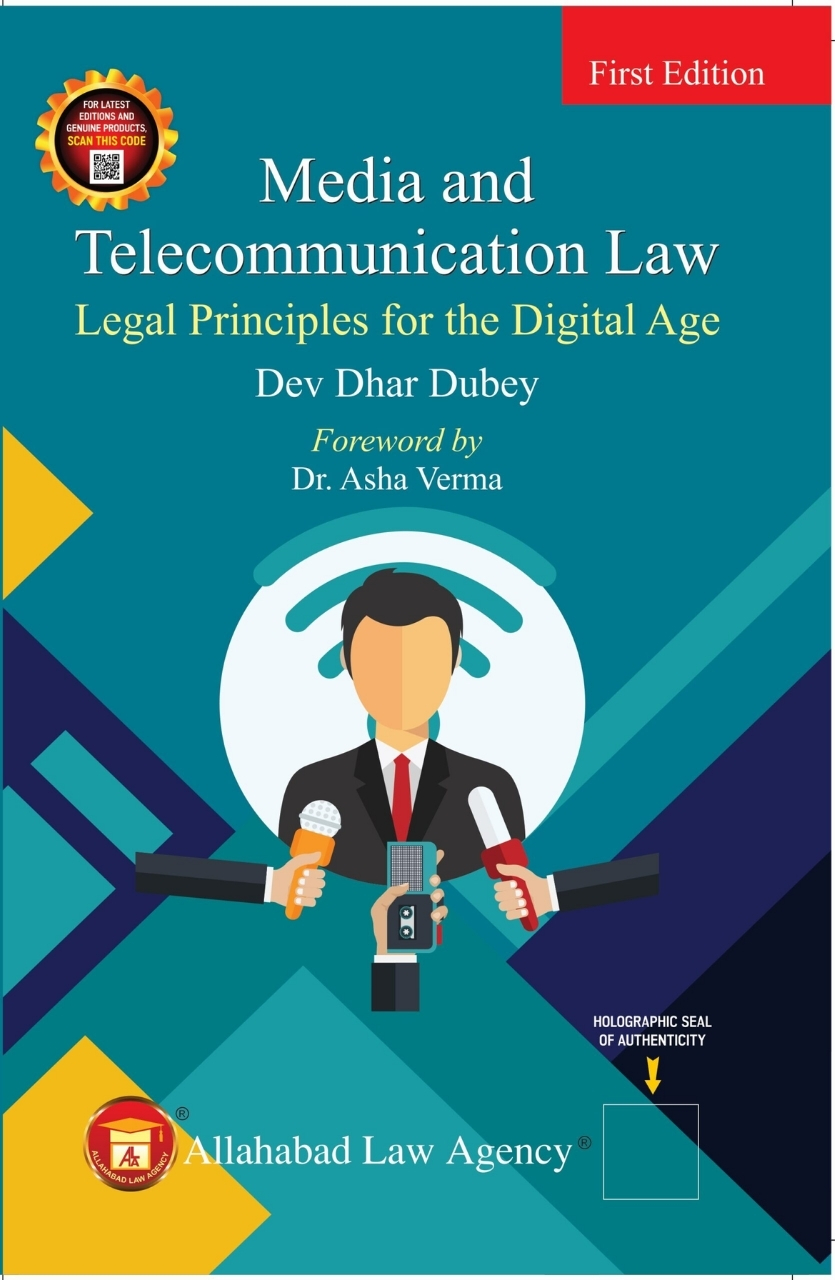
Media And Telecommunication Law Legal Principles for the Digital Age-Dev Dhar Dubey is a law textbook published by Allahabad Law Agency.
Written with the needs of law students in mind, it explains the principles and provisions of the subject in a systematic and readable manner, making it a dependable companion for coursework and examination preparation.
Key highlights:
- Systematic, student-friendly treatment of the subject
- Suited to the LL.B. syllabus and competitive examinations
- A trusted Allahabad Law Agency title
What’s Inside — Complete Chapter Map (20 Chapters)
Subtitled Legal Principles for the Digital Age, with a Table of Cases and a full bibliography of books, articles and statutes.
Chapters 1–2 — Foundations: the history of media from oral tradition and inscriptions through the colonial printing press, the vernacular press and the nationalist newspapers, the role of media in the freedom struggle, and the post-independence era · the evolution of media technology to convergence and mobile · the impact of media law on a democratic society · media regulation from the colonial era to the digital one · then each type of media with its legal considerations — print (press freedom, content regulation, copyright, ownership limits), broadcast (television and radio, advertising rules, election coverage), digital (content regulation, privacy and data protection, cybersecurity, cross-border jurisdiction, intermediary liability), advertising and marketing (standards, comparative advertising, product placement, and the special rules for alcohol, tobacco and pharmaceuticals), entertainment (IP, licensing, censorship, film certification), and social and citizen media.
Chapters 3–5 — Freedom of expression: the constitutional provisions and the reasonable restrictions, with the Supreme Court’s landmark decisions · derivative media rights under Article 19, each with its statutory basis and leading cases — the right to know, to broadcast, to publicity, to reply, against compelled speech, of commercial speech, of circulation, to decide page and price, to conduct interviews, to criticise, and not to speak · and media freedom and censorship — the constitutional status, parliamentary privileges, and the twelve censorship statutes from the Cable Television Networks Act and Cinematograph Act to the Official Secrets Act and Contempt of Courts Act.
Chapters 6–9 — Regulation in practice: the Press Council of India and content restrictions on print media, with defamation and obscenity keyed to the Bharatiya Nyaya Sanhita, 2023 section numbers · broadcasting regulation — the Cable Television Networks Act, Prasar Bharati Act, TRAI Act and Telegraph Act, licensing for radio and television, programme and advertising codes, political advertising, must-carry obligations and the digital transition · internet and digital media law — the IT Act, the Intermediary Guidelines and Digital Media Ethics Code 2021, the DPDP Act 2023, intermediary liability, online harassment and hate speech, content blocking, and copyright in the digital age · and privacy and media law — the Puttaswamy watershed, data collection and consent, surveillance, the right to be forgotten, the Aadhaar controversy, the key privacy precedents, and the DPDP Act 2023 examined across ten dimensions.
Chapters 10–15 — Media and public life: election laws and the media — the Model Code of Conduct, paid news, restrictions on political advertising and the silent period, exit and opinion polls · national security — reporting on terrorism and defence, the Official Secrets Act, whistleblowing and protection of sources, with the Balakot, Kargil, Rafale, Operation Blue Star, surgical strikes and Panama Papers case studies · copyright — the rights in each class of work clause by clause, duration, fair use, infringement and remedies, digital piracy, fair use in news reporting, and trademarks and product placement · media ethics and self-regulation — the ethical codes, the Press Council and the News Broadcasting Standards Authority, with case studies on paid news, sensationalism and sting operations · defamation — civil and criminal defamation under Section 356 BNS, the defences, public figures, and five recent case studies · and media trials — their impact on fair trial and the presumption of innocence, contempt of court, and international comparisons.
Chapters 16–20 — Emerging and international: media ownership and concentration — cross-media ownership in its five forms, the regulatory framework, FDI rules and the impact on pluralism · media convergence and its regulatory challenges · emerging technologies — AI, virtual reality and blockchain and their implications for content authentication and moderation · international perspectives comparing India with the USA and UK on expression, regulation, ownership and defamation, and the international human rights instruments · telecommunication law — its history in India, the regulatory framework, TRAI and the DoT, licensing and spectrum allocation, consumer rights and competition · thirteen landmark judgments discussed in full · and the Right to Information — its historical context, constitutional foundations, key provisions of the 2005 Act, the media’s role in access to information, and investigative journalism including the 2G, Adarsh and Commonwealth Games exposés.
Reviews
There are no reviews yet.