
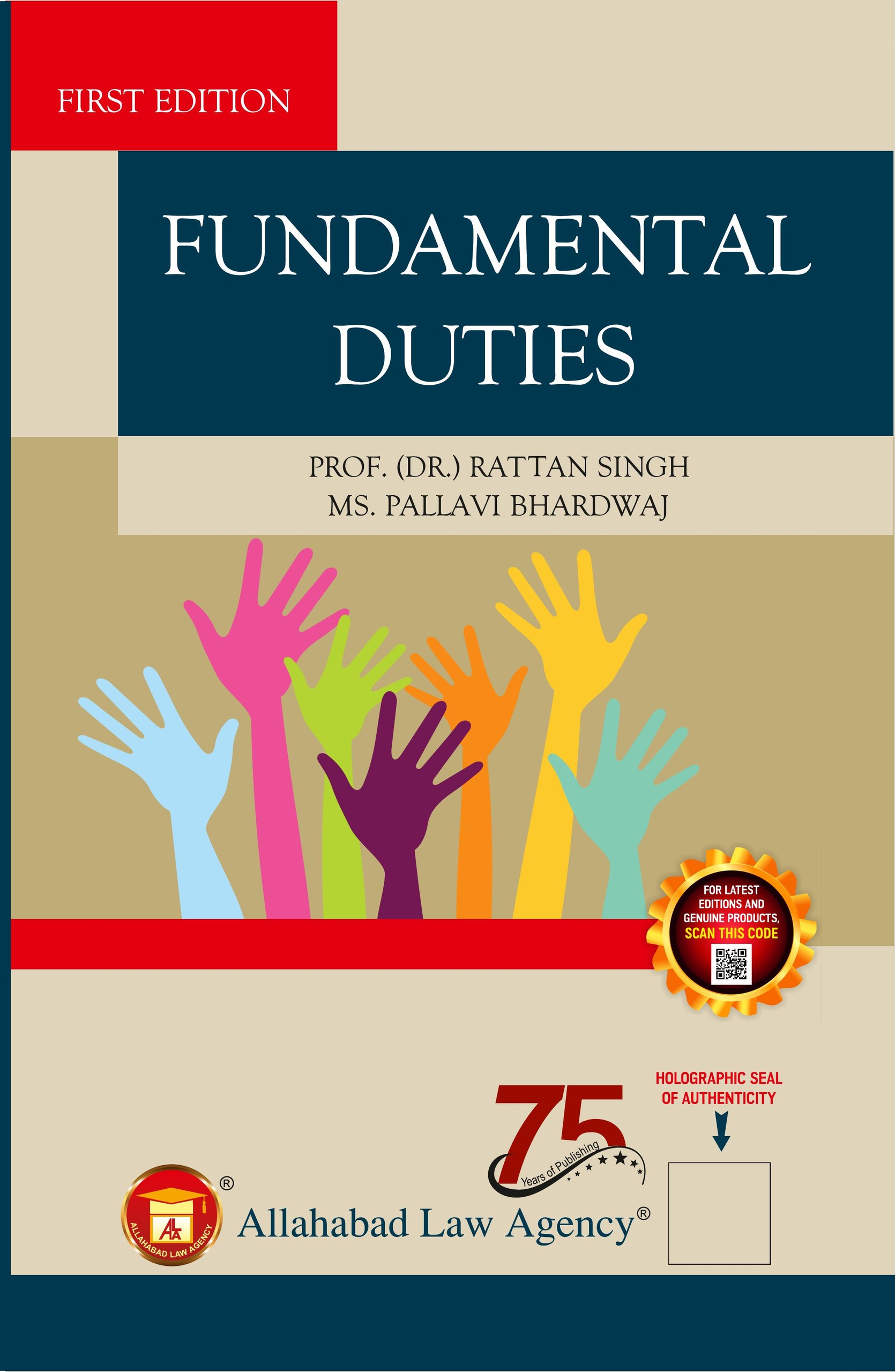
The eleven Fundamental Duties under Article 51A are the most under-taught yet increasingly examined corner of the Constitution — and this focused primer by Dr. Rattan Singh and Ms. Pallavi Bhardwaj fills exactly that gap. It traces the duties from the Swaran Singh Committee and the 42nd Amendment, 1976, through the addition of the education duty by the 86th Amendment, analysing each duty with the case law that gives it teeth — AIIMS Students’ Union, Ranganath Mishra, and the environmental and flag-code jurisprudence built on Articles 51A(g) and (a).
The interplay of duties with Fundamental Rights and Directive Principles — a favourite of Constitutional Law examiners and judiciary interview boards — gets dedicated treatment. At ₹175, a compact 2026 addition to any constitutional law shelf.
Allahabad Law Agency — 75 years of trusted law publishing.
What’s Inside — Complete Chapter Map (6 Chapters)
Chapter 1 — The Conceptual Note: rights and duties and how they evolved · the idea of duty in Indian civilisation · the meaning and types of duty and the correlation between rights and duties · the Indian Constitution and the Fundamental Duties · and the three official reviews — the Swaran Singh Committee 1976, the Verma Committee on Fundamental Duties 1999 and the Law Commission report.
Chapter 2 — Importance of Duties Today: the ten factors that impede the performance of duties — poverty and social stratification, indiscipline and weak legislation, lack of education and awareness, population and metropolitan culture, corruption and inadequate training, indifference and lack of political will, separatist tendencies, absent work ethos, foreign cultural influence, and an underdeveloped patriotic spirit · the apprehensions about making duties explicit · the relevance of duties in the contemporary world and law’s role as a catalyst · citizens’ dynamism, the judicial trend and growing awareness · and the implementation of the Good Samaritan law.
Chapter 3 — Article 51A: Fundamental Duties and the socialist State · a comparative survey of duties in Germany, Australia, Uganda, Sri Lanka, China, the UK, the USSR constitutions of 1936, 1977 and 1993, and Russia · then each of the eleven duties under Article 51A taken in turn, grouped as national (a-d), social (e, f, i), environmental (g), towards oneself (h, j) and towards the world at large (k) — from respect for the Constitution, the National Flag and Anthem, through common brotherhood and renouncing practices derogatory to the dignity of women, preservation of composite culture, protection of the natural environment and compassion for living creatures, the scientific temper, safeguarding public property and abjuring violence, striving towards excellence, and the parent’s duty to provide education between six and fourteen · with the transnational perspective on duties.
Chapter 4 — Fundamental Duties and Fundamental Rights: the interplay with the prohibition of discrimination, abolition of untouchability and titles, and the prohibition of traffic in human beings and forced labour · duties in the ancient Indian perspective and as imbibed within the Fundamental Rights · the evolving jurisprudence including Austin’s view · the need for codified duties and the government’s four-fold response — awareness, inculcation, aspiration and implementation · the enforcement of Fundamental Duties through seven leading decisions including the AIIMS Students Union, Aruna Roy, Mirzapur Moti Kureshi and Vellore Citizens’ Welfare Forum cases · the nature of Fundamental Rights as discussed in Kesavananda Bharati · and duties as reasonable restrictions in the Ramlila Maidan case.
Chapter 5 — Fundamental Duties and the Directive Principles: a paired comparison — Article 42 with 51A(e) on the dignity of women, Article 45 with 51A(k) on early childhood care and education, Article 48A with 51A(g) on environmental protection, and Article 49 with 51A(f) on cultural heritage · the welfare-State model in India and the obligations of the State against those of the citizen · the legal and environmental jurisprudence that has grown around Article 51A(g) · the reports on Fundamental Duties, a critical analysis, and the role of NGOs in generating awareness.
Chapter 6 — Evolving Jurisprudence: the recent decisions including Durga Dutt v. Union of India (2024) and the Ranganath Mishra case · enforcement before and after the 42nd Amendment Act, 1976 · the judicial trend, the drawbacks in enforcement, the tension between enforceability and locus standi, the individualisation of duties, and the criticism and sanctity of Fundamental Duties · with a bibliography.


AK –
It is an amazing book, talking at length about duties. Authors have done remarkable job.
admin (store manager) –
Thanks
Simran Sidhu –
The book is not that much lengthy. has a very good and strong content. The Authors have done a great job!
admin (store manager) –
Thanks