
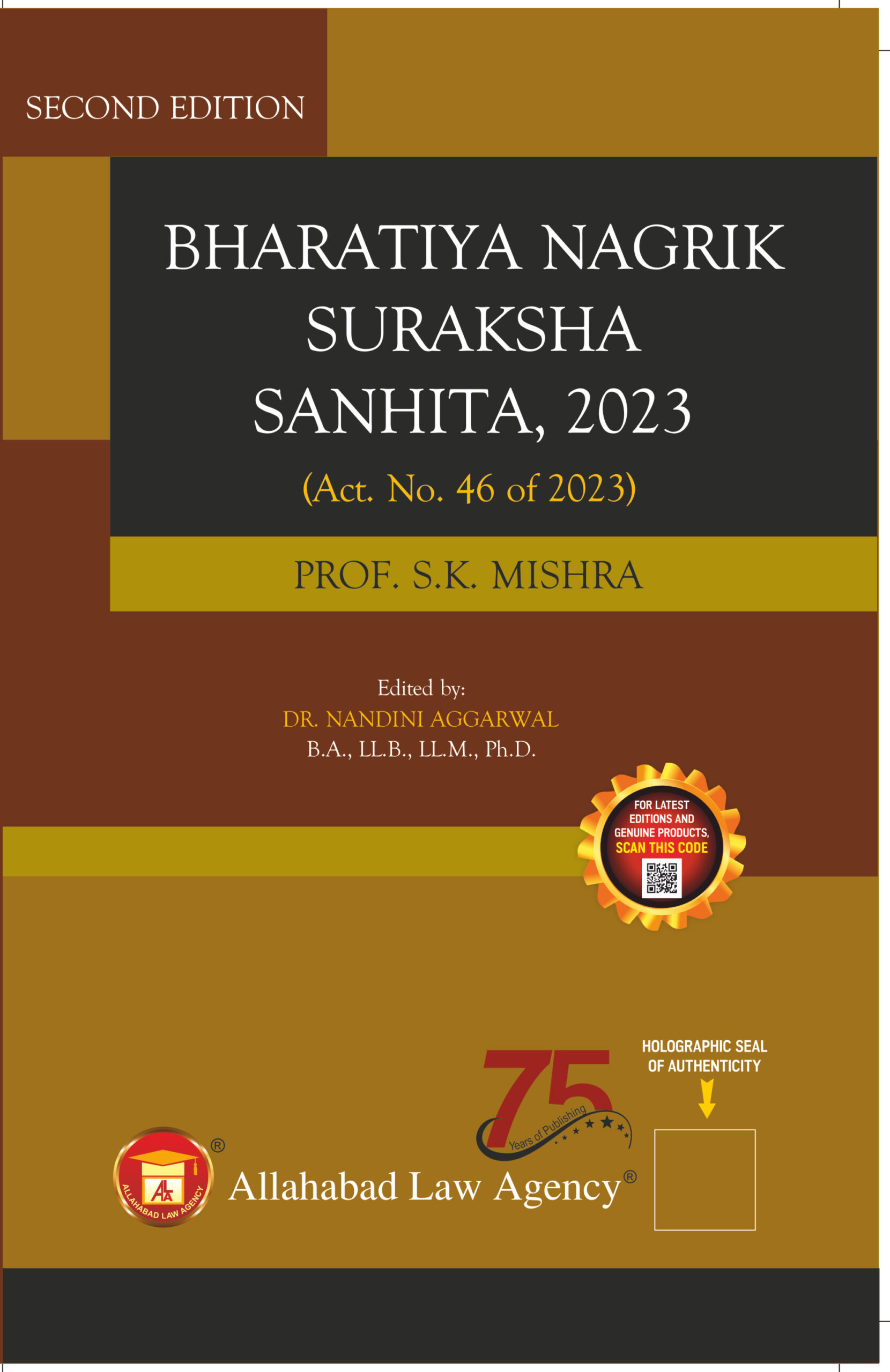

Bharatiya Nagarik Suraksha Sanhita,2023 by S.K. Mishra is a law textbook published by Allahabad Law Agency.
Written with the needs of law students in mind, it explains the principles and provisions of the subject in a systematic and readable manner, making it a dependable companion for coursework and examination preparation.
Key highlights:
- Systematic, student-friendly treatment of the subject
- Suited to the LL.B. syllabus and competitive examinations
- A trusted Allahabad Law Agency title
What’s Inside — Complete Coverage Map (15 Parts)
The book opens with a comparative chart between the CrPC, 1973 and the Bharatiya Nagarik Suraksha Sanhita, 2023 and a Table of Cases, then works through the new procedure code part by part rather than section by section — the arrangement practitioners and students actually use.
Part I — Introductory: the historical evolution of criminal procedure and the major key changes brought by the BNSS — bail and bail bonds, prescribed time periods, electronic audio-video evidence, “pleader” replaced by “advocate”, the power to use handcuffs, and the period of police remand · the Preamble, short title and definitions · trial of offences under the Bharatiya Nyaya Sanhita · speedy trial under Article 21 · considerations in awarding sentence.
Part II — Powers and Duties of Police: powers of superior officers · arrest (Ss. 35–62) — arrest without warrant, procedure and duties of the arresting officer, the right to meet an advocate during interrogation, information of grounds of arrest and of the right to bail, and medical examination of the arrested person · investigation (Ss. 173–196) — information in cognizable cases and Zero FIR, options where an FIR is refused, the police officer’s power to investigate with a full treatment of the difference between Section 156 CrPC and Section 175 BNSS and the construction of Section 175(3) and (4), examination of witnesses, statements to police, recording of confessions (S. 183), search, the procedure when investigation cannot be completed in twenty-four hours (S. 187), the police report on completion of investigation (S. 193) and the prescribed time limits · duties to prevent cognizable offences.
Part III — Criminal Courts and Jurisdiction: classes of criminal courts, territorial divisions, Sessions and Magistrates’ courts, Executive Magistrates, Public Prosecutors and the Directorate of Prosecution, and the sentences each court may pass.
Parts IV–VI — Process, Powers and Trials: summons, warrants, proclamation and attachment · search-warrants and general provisions relating to searches · attachment and forfeiture of property · security for keeping the peace · maintenance of wives, children and parents (Ss. 144–147) · public order, public nuisance and disputes as to immovable property · conditions requisite for initiation of proceedings and cognizance · framing and joinder of charges · Sessions trials, summary trials and plea bargaining · private complaint cases and police cases · accused persons of unsound mind · offences affecting the administration of justice · general provisions as to inquiries and trials including examination of the accused (S. 351) · and the Judgment (Ss. 392–406) with an extended set of practice notes on dying declarations, circumstantial evidence, sole-eyewitness convictions, sanction, compensation and quashing.
Parts VII–XV — After the trial: Appeals — when appeals lie and do not, appeals against sentence and acquittal, and the duties of the appellate court · Reference, Revision and the inherent powers of the High Court under Section 528 (the successor to Section 482 CrPC), with the limits the Supreme Court has set · transfer and withdrawal of cases · execution, suspension, remission and commutation of sentences, including the jurisprudence on delay in executing a death sentence · bails, bonds and paroles — considerations for grant and refusal, anticipatory bail, statutory bail, and the distinction between bail and parole · disposal of property · irregular proceedings · limitation for taking cognizance (Ss. 513–519) · and miscellaneous provisions including inquiries on private complaint and probation of offenders.


Reviews
There are no reviews yet.