
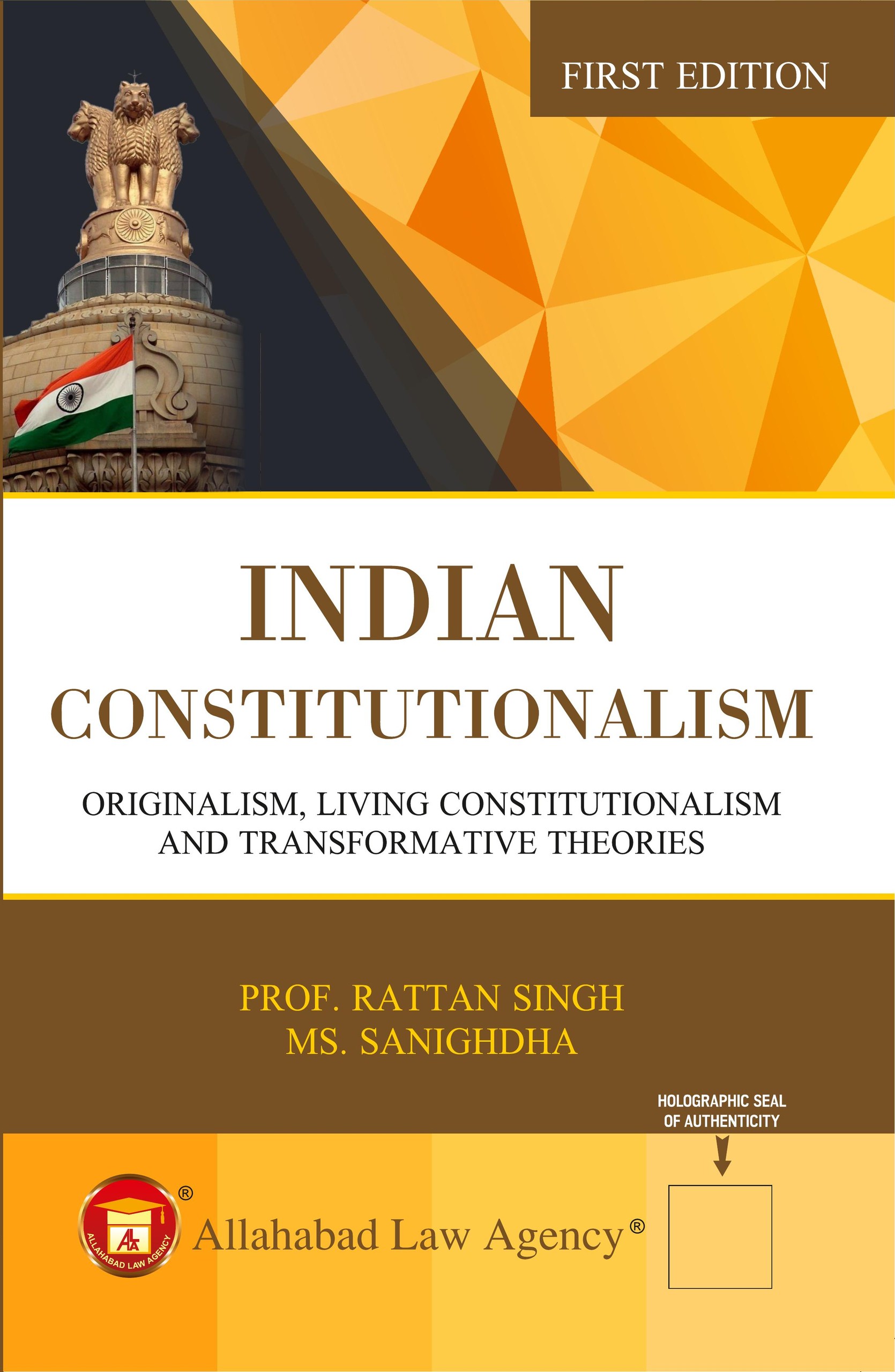

How should a Constitution written in 1950 be read in the 2020s? Prof. Rattan Singh’s Indian Constitutionalism tackles the interpretive debate at the heart of modern constitutional law — originalism versus the living Constitution — in the Indian context. The book examines how the Supreme Court has actually navigated the choice: the transformation of Article 21, the basic structure doctrine as a living-constitutionalist device, constitutional morality in the recent privacy and equality decisions, and the counter-arguments grounded in constituent-assembly intent.
Compact and sharply argued, it is ideal supplementary reading for constitutional law papers, LLM seminars, and interview-stage judiciary preparation — the kind of book that lifts an answer from correct to distinguished. 2025 edition.
Allahabad Law Agency — 75 years of academic law publishing.
Indian Constitutionalism by Prof. Rattan Singh is a law textbook published by Allahabad Law Agency.
Written with the needs of law students in mind, it explains the principles and provisions of the subject in a systematic and readable manner, making it a dependable companion for coursework and examination preparation.
Key highlights:
- Systematic, student-friendly treatment of the subject
- Suited to the LL.B. syllabus and competitive examinations
- A trusted Allahabad Law Agency title
What’s Inside — Complete Chapter Map (8 Chapters)
Subtitled Originalism, Living Constitutionalism and Transformative Theories, this is a theory-led study of how the Indian Constitution is interpreted — written for LLM students, research scholars and teachers rather than as a bare article-by-article commentary.
Chapter 1 — The Constitution: what a constitution is, and the twenty salient facets of the Indian Constitution — the lengthiest written constitution, parliamentary government, its blend of rigidity and flexibility, Fundamental Rights, separation of powers, single citizenship, the Directive Principles, federalism with a strong centralising tendency, universal adult franchise, an independent judiciary, rule of law, judicial review, the basic structure doctrine, Fundamental Duties, Centre-State relations, emergency and amendment provisions, the Election Commission, the powers of the President, and the Preamble.
Chapter 2 — Originalism: the origin of the doctrine and the eight phases of its growth — original intention of the framers, the original understanding of those intentions, the intention of the ratifiers, “We the People”, original public meaning and New Originalism, original application and original methods, the critique of New Originalism, and the understanding of the voters · the case precedents showing an originalist approach in Indian constitutional interpretation · textualism, contextualism and intentionalism compared · and the pitfalls of the doctrine.
Chapter 3 — Constitutionalism: constitutionalism and the principles of democracy — popular sovereignty, checks and balances, responsible government, rule of law and an independent judiciary · the six types of constitutionalism — originalist, democratic, libertarian, living, meta and digital constitutionalism · and constitutionalism in Indian democracy through the basic structure doctrine, supremacy of the Constitution, the doctrine of proportionality, judicial review, legitimate expectations and reasonable restrictions.
Chapter 4 — Living Constitutionalism: the six modes of constitutional interpretation (historical, textual, prudential, doctrinal, structural and ethical) · the growth of living constitutionalism in America through its leading decisions · and its growth in India, traced from the textualist “silos” approach through the contextualist shift to the living-constitutionalist stage — the right to live with human dignity, reputation, shelter and livelihood, environmental constitutionalism (a pollution-free environment, sustainable development, freedom from noise pollution), the right against harassment of women at workplaces, the right to education, and the expansion of locus standi through public interest litigation.
Chapter 5 — Originalism and Living Constitutionalism Contrasted: their historical origins, belief systems and sub-categories — original intentions, original public understanding and regime theory on one side; constitutional pluralism, moral readings, common-law, popular and extra-national constitutionalism (transnational, global, treaty, multiple-meaning and super-legislative), Thayerianism in its three forms, constitutional antitheory (particularism, pragmatism, eclecticism, opportunism and rejectionism) and contemporary ratification theory on the other · the basic structure doctrine studied through both lenses · and the eleven branches of living constitutionalism from socialistic to world constitutionalism.
Chapter 6 — Theories of Constitutional Interpretation: a bird’s-eye view of textualism, originalism, doctrinalism, structuralism and living constitutionalism, then prudentialism and purposive interpretation, fundamental rights and judicial review, harmonious construction, legitimate expectations, severability, federal supremacy, territorial nexus and casus omissus.
Chapter 7 — The United Kingdom and Canada: living constitutionalism in the UK — its easy amendment procedure, unwritten constitution, common-law system, the authority of the Supreme Court and human rights · and in Canada, through the living tree doctrine and its leading references.
Chapter 8 — Transformative and Digital Constitutionalism: transformative constitutionalism as developed in South Africa and in India — decriminalisation of same-sex relationships, the right against harassment, women’s property rights and coparcenary, the right to privacy, environmental constitutionalism, equality in worship, guardianship, reproductive autonomy, maintenance and the right to marry a person of one’s choice · digital constitutionalism through the leading Indian decisions on online speech, intermediaries and electronic evidence, and the newer developments — the Digital Personal Data Protection Act, 2023, judicial digital repositories, e-Courts and virtual courts, e-Seva Kendras, SUVAAS, SUPACE and the National Judicial Data Grid · with a full bibliography of primary and secondary sources.
AMITKUMAR DAVE (verified owner) –
Excellent
admin (store manager) –
Thank you for rating Prof. Rattan Singh’s Indian Constitutionalism 5 stars, Mr. Dave. Do let us know if you need any other subject from our list. A humble request — a short review on Google helps other students discover us: https://search.google.com/local/writereview?placeid=ChIJbzPN5sDdDDkR4re7TE2zmy0
Warm regards,
Allahabad Law Agency