
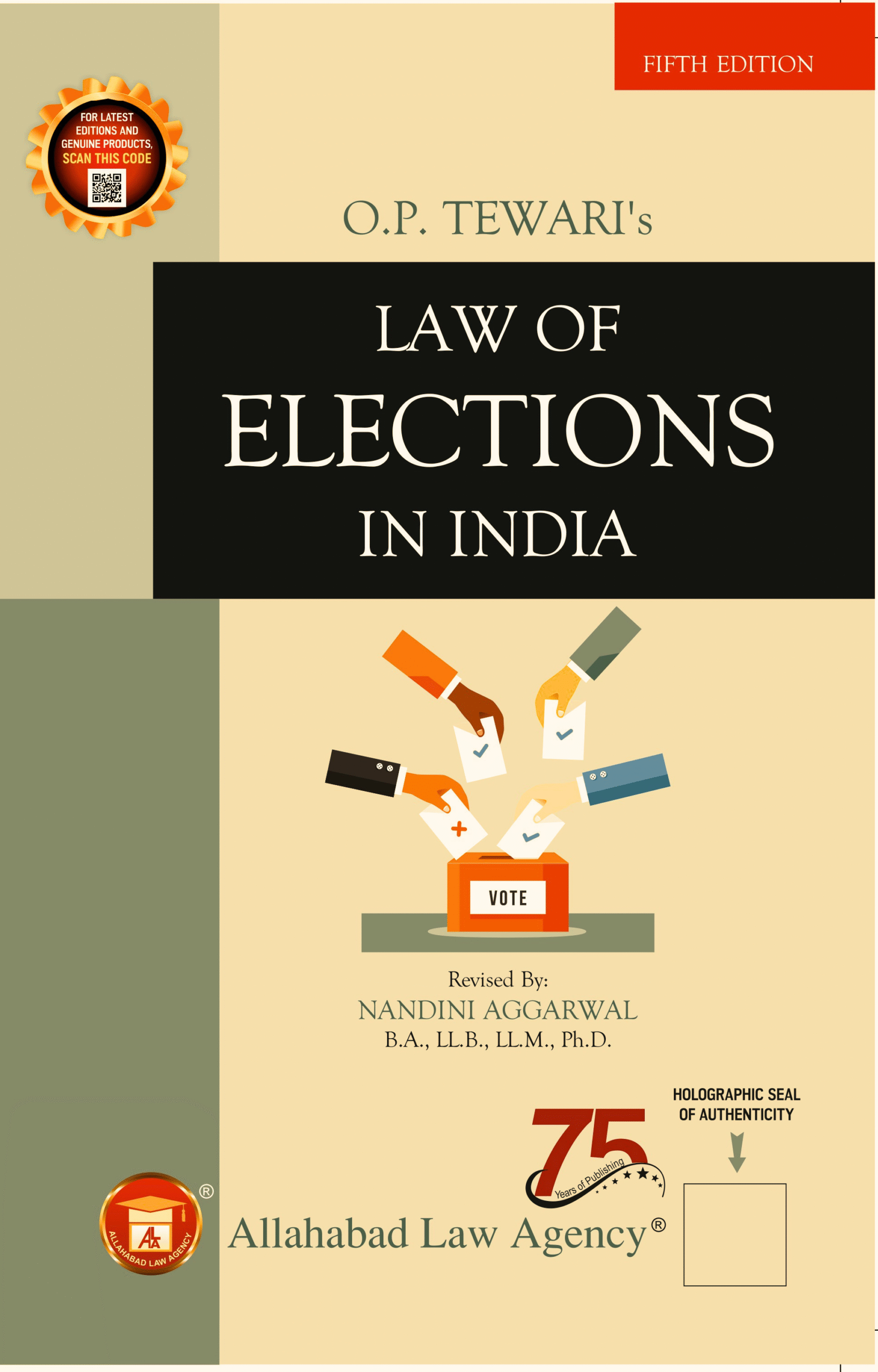

Law of Elections in India by O.P Tewari`s is a law textbook published by Allahabad Law Agency.
Written with the needs of law students in mind, it explains the principles and provisions of the subject in a systematic and readable manner, making it a dependable companion for coursework and examination preparation.
Key highlights:
- Systematic, student-friendly treatment of the subject
- Suited to the LL.B. syllabus and competitive examinations
- A trusted Allahabad Law Agency title
What’s Inside — Complete Coverage Map (4 Parts)
Now in its Fifth Edition and updated to the newest position — including the Chief Election Commissioner and Other Election Commissioners Act, 2023, the simultaneous-elections debate, and the election-related provisions of the Bharatiya Nyaya Sanhita, 2023.
Part I — Introductory and Framework (4 chapters): the advent and development of constitutional democracy, the constitutional provisions relating to elections, and the international covenants · practical questions treated with authority — who is a candidate, the position of an election agent, consequences of establishing corrupt practices, claims and objections to electoral rolls, when an election petition may be dismissed in limine for defective pleadings, the scope of the trial court’s powers, the role of money in the election process, admissibility of tape-recorded statements, the High Court’s powers under Article 226, and the settled principle that the right to elect is a statutory right, not a fundamental or common-law one · meaning and types of elections — first-past-the-post and proportional representation, delimitation, preparation of electoral rolls, voter registration, eligibility and disqualification · the Election Commission — appointment of the CEC and Election Commissioners, the key features of the 2023 Act, salary and conditions, resignation and removal, and the Commission’s powers where no constitutional or legislative provision exists · Simultaneous Elections: One Country, One Election — elections at Union, State and local level, the history of simultaneous elections, the reasons for and difficulties in conducting them, the existing constitutional and statutory provisions, and the formulas suggested by the Law Commission, the Parliamentary Standing Committee and the High-Level Committee.
Part II — The Representation of the People Act, 1950, section by section: allocation of seats and delimitation of parliamentary and assembly constituencies, the Delimitation Orders and the Commission’s power to keep them up to date, reservation of constituencies · electoral officers — chief electoral officers, district election officers and electoral registration officers · electoral rolls for parliamentary, assembly and council constituencies — disqualifications for registration, the bar on registration in more than one constituency, the meaning of “ordinarily resident“, preparation and revision of rolls, correction of entries, inclusion of names and appeals · the manner of filling Council of States seats allotted to Union Territories · and the general provisions, with the four Schedules.
Part III — The Representation of the People Act, 1951, the core of the book: qualifications for membership of Parliament and the State legislatures · disqualifications — on conviction for certain offences (Section 8), on the ground of corrupt practices, for government contracts, and for failure to lodge an account of election expenses, with removal and reduction of the period · notification of general elections · the administrative machinery — observers, returning and presiding officers and their duties · registration of political parties (Sections 29A–29C) including contributions and declaration of donations · conduct of elections — nomination and scrutiny of candidates, the right to information under Section 33A, deposits, withdrawal, election agents, polling and counting agents · the poll — adjournment in emergencies, fresh poll, booth capturing, voting machines, the right to vote and the method of voting · counting of votes and declaration of results · multiple elections · declaration of assets and liabilities · election expenses and the statutory maximum (Sections 76–78) · disputes regarding elections — presentation, parties and contents of an election petition, trial before the High Court, documentary evidence, secrecy of voting, recrimination, the grounds for declaring an election void (Section 100), withdrawal and abatement, appeals to the Supreme Court, and costs · corrupt practices (Section 123) and the full list of electoral offences — promoting enmity, false affidavits, the 48-hour prohibition on public meetings, restrictions on exit polls, disturbances at meetings, secrecy of voting, canvassing near polling stations, booth capturing, paid holiday for employees and the liquor prohibition on polling day · powers of the Election Commission in inquiries as to disqualification · by-elections and casual vacancies · and the miscellaneous provisions on requisitioning premises and vehicles.
Part IV — Appendices: the Parliament (Prevention of Disqualification) Act, 1959 · the maximum election expenses under the Conduct of Election Rules, 1961 · extracts from the Constitution relating to the democratic set-up · extracts from the Bharatiya Nyaya Sanhita, 2023 relating to elections · and the international declarations and covenants on democracy.


Reviews
There are no reviews yet.