
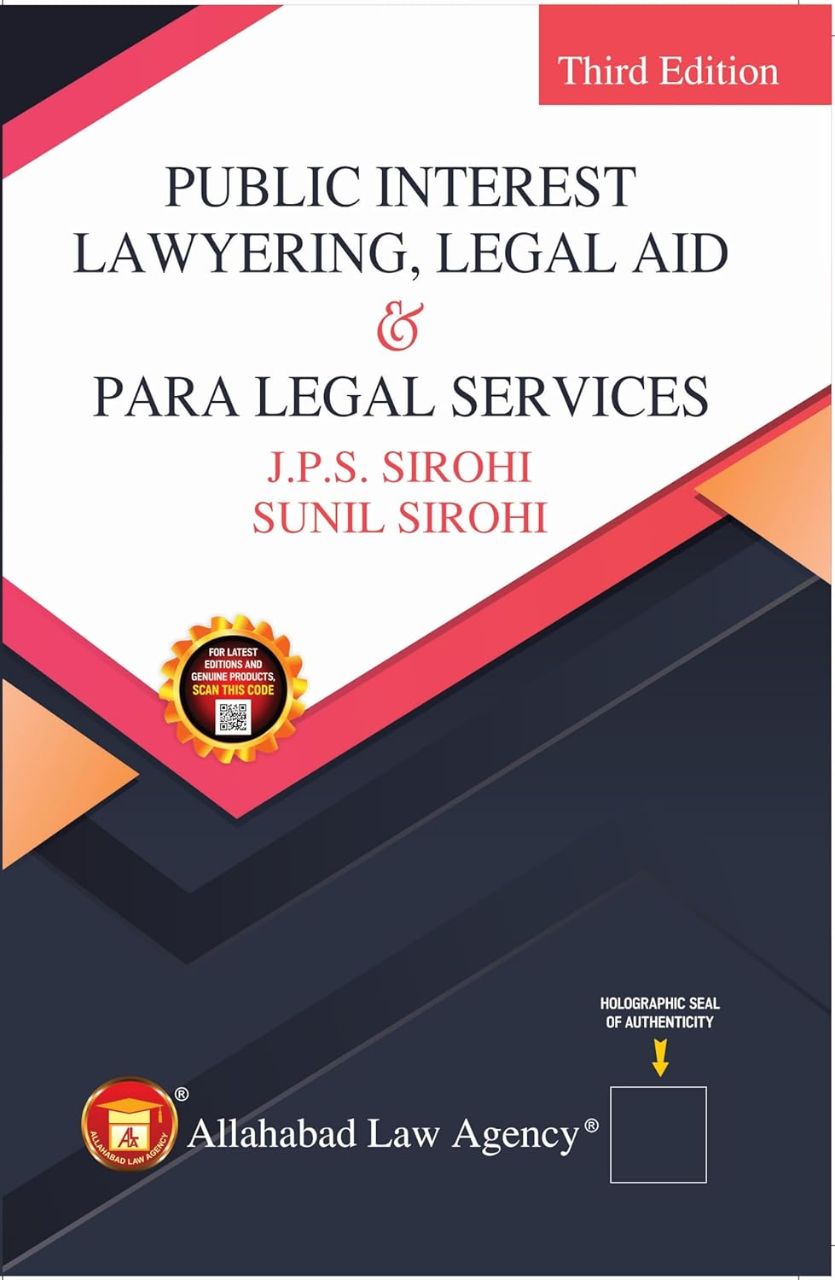

Public Interest Lawyering,Legal Aid & Para Legal Services by J.P.S Sirohi is a law textbook published by Allahabad Law Agency.
Written with the needs of law students in mind, it explains the principles and provisions of the subject in a systematic and readable manner, making it a dependable companion for coursework and examination preparation.
Key highlights:
- Systematic, student-friendly treatment of the subject
- Suited to the LL.B. syllabus and competitive examinations
- A trusted Allahabad Law Agency title
What’s Inside — Complete Chapter Map (10 Chapters + 3 Appendices)
Written for the Bar Council’s practical paper on Public Interest Lawyering, Legal Aid and Para-Legal Services, and updated to the current statutory position — including references to the BNSS, 2023 and the Mediation Act, 2023.
Chapter I — Right to Legal Practice and Professional Conduct: conditions for the right to practise, State Bar Councils and the Bar Council of India and their functions, disciplinary proceedings and professional misconduct, appeals to the BCI and the Supreme Court, and protection of an advocate’s right to conduct a case. Chapter II — Rule of Law: its ingredients, at common law and in equity, the American position, the position in India, Article 142, and contempt of court.
Chapter III — Public Interest Litigation: origin and meaning, PIL and executive bodies, locus standi including in criminal cases, vexatious and frivolous PILs, the Supreme Court’s guidelines, writ jurisdiction, and the relationship between the legal aid movement and PIL. Chapter IV — Landmark PIL decisions arranged by theme: right to life and liberty, custodial torture, ecology and noise pollution, protection of children, sexual harassment of working women, disinvestment cases, misapplication of public funds, withdrawal of criminal cases, PILs founded on letters and newspaper reports, and the parameters courts now apply.
Chapter V — Legal Services and Legal Aid: constitutional safeguards and the Legal Services Authorities Act, 1987, the Central, State, High Court and District authorities and committees with their regulations, Lok Adalats and Permanent Lok Adalats, and ADR through mediation with state-by-state practice. Chapter VI — Para-Legal Services: the growth of tribunals in India, the UK and the USA, their functions and powers, the Central Administrative Tribunal, Income Tax Appellate, Industrial and Railway Rates Tribunals, domestic tribunals, the Election Commission, the Information Commissions under the RTI Act, 2005, and the human rights commissions.
Chapter VII — Consumer Disputes Redressal Forums: the Consumer Protection Act, 2019 machinery — councils, the Central Consumer Protection Authority, District, State and National Commissions and appeals, product liability, compounding of offences, the effect of the Mediation Act 2023, the 2020 Rules and model forms of notice, complaint, affidavit and written statement. Chapter VIII — Lokpal and Lokayukta (Ombudsman) in India and abroad. Chapter IX — Fundamental Principles of Advocacy: competent representation, issue diagnosis, legal reasoning and research, document analysis, communication, counselling and negotiation. Chapter X — Legal Education in India and the Bar Council’s curriculum requirements.
Appendices: the Legal Services Authorities Act, 1987, and the Punjab and West Bengal Consumer Protection Rules.

Reviews
There are no reviews yet.