
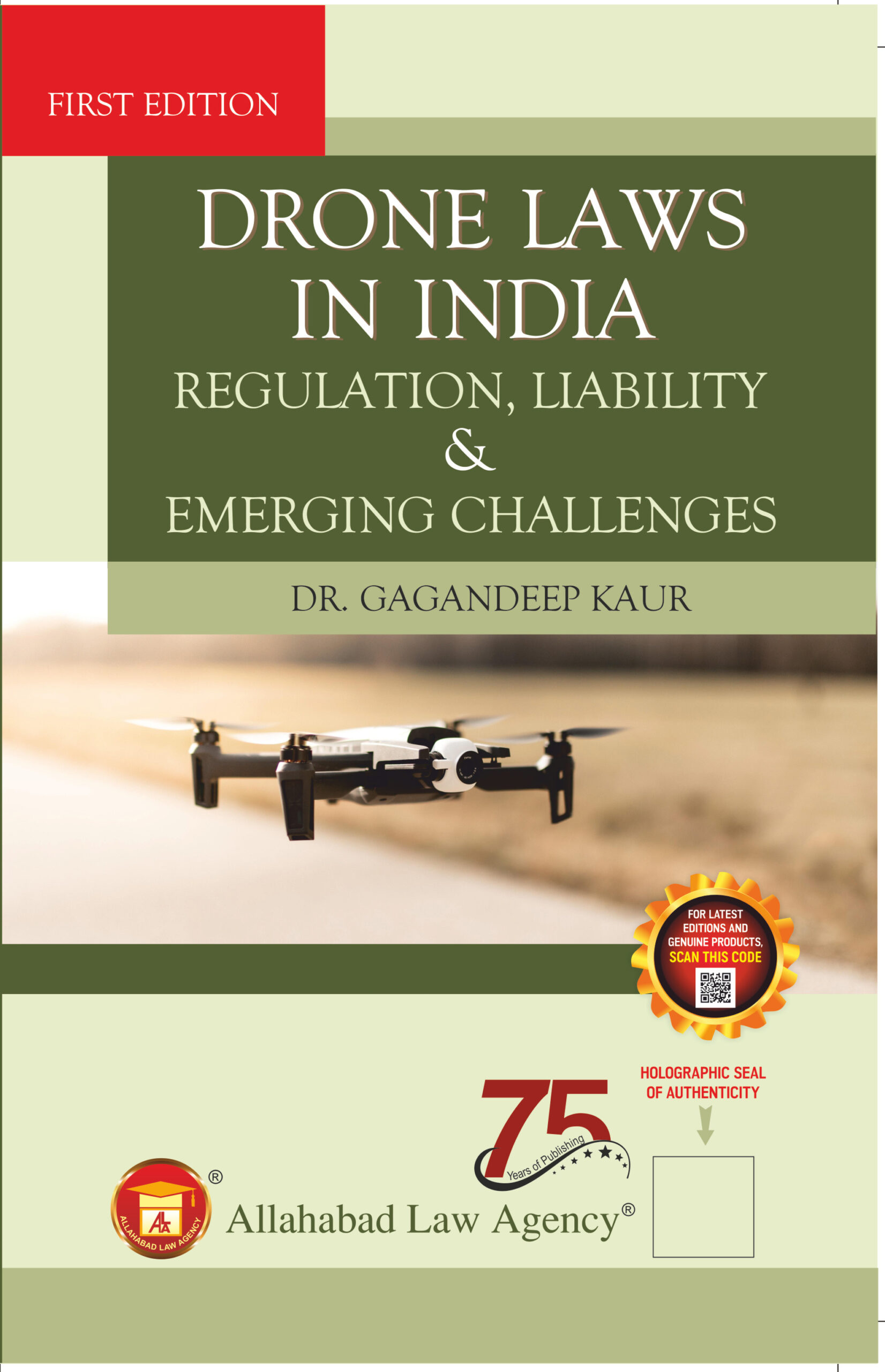
Dr. Gagandeep Kaur’s Drone Laws in India is among the first dedicated Indian texts on the law of unmanned aircraft — a fast-moving field where technology has outpaced established legal categories. The book sets out the regulatory framework governing drones in India, including the Drone Rules, 2021 and the DGCA regime, airspace zoning (the green, yellow and red zones), registration and the Unique Identification Number, pilot certification, and the conditions for lawful operation.
Beyond the rules, it engages the harder questions the subject raises: civil and criminal liability for damage and trespass, the privacy and surveillance concerns of aerial data collection, insurance, and the emerging challenges of commercial delivery, agriculture, policing and defence uses. Current to 2026, it is a valuable resource for technology-law and aviation-law electives, researchers, and practitioners advising in this developing area.
Allahabad Law Agency — genuine copies carry the holographic seal.
Drone Laws in India by Dr. Gagandeep Kaur is a law textbook published by Allahabad Law Agency. Written with the needs of law students in mind, it explains the principles and provisions of the subject in a systematic and readable manner, making it a dependable companion for coursework and examination preparation.
Key highlights:
- Systematic, student-friendly treatment of an emerging subject
- Suited to LL.B. / LL.M. electives and research
- A trusted Allahabad Law Agency title
What’s Inside — Complete Chapter Map (11 Chapters + Cases, MCQs and the Drone Rules)
Every chapter closes with Short Questions and Answers and a reference list, and the book ends with three landmark cases, 100 multiple-choice questions with answers arranged chapter by chapter, and the Drone Rules, 2021 — making it usable as a textbook, a revision aid and a practitioner’s reference at once.
Chapters 1–3 — Technology and regulation: what a drone is, its economic, humanitarian, environmental and defence significance, its characteristics, and the six types from multi-rotor and fixed-wing to nano and underwater vehicles, with the future of autonomous operations, urban air mobility and swarm intelligence · the historical evolution of drone regulation through the pre-regulatory, prohibition and contemporary phases · the international architecture — ICAO standards and unmanned traffic management — followed by the United States (FAA Part 107, waivers and remote identification), the European Union (the three operational categories and SORA), the post-Brexit United Kingdom, China and India · then a detailed examination of India’s framework — the classification system, the Digital Sky Platform, registration and certification, and operational limitations — with a thematic comparison against Australia, Japan, Singapore, China, the USA, Canada, Brazil, the EU, the UAE and South Africa.
Chapters 4–5 — Privacy and liability: the theoretical foundations of privacy in the drone context — reasonable expectation of privacy, the mosaic theory of aggregated surveillance and informational self-determination · the constitutional and statutory frameworks compared (India’s right to privacy and the Digital Personal Data Protection Act 2023, the US Fourth Amendment, the EU’s GDPR) · the types of drone surveillance from visual and thermal imaging to communications interception and algorithmic analysis, with the special contexts of law enforcement and national security, and the remedies available · then liability — negligence, strict and vicarious liability, India’s framework under tort law, the Carriage by Air Act 1972 and the Drone Rules 2021, the comparative positions, specific scenarios (mid-air collisions, ground impact, autonomous system failures), drone insurance and its gaps, and the emerging questions raised by delivery services and swarm operations.
Chapters 6–7 — Crime and property: the categories of drone-related criminal conduct — regulatory offences, privacy and surveillance offences, smuggling, and interference with critical infrastructure · terrorism and national security including weaponisation, the UAPA and cross-border incursions · India’s criminal law framework under the Bharatiya Nyaya Sanhita, 2023 and the Aircraft Act 1934, with counter-drone measures and evidentiary issues · then property rights and airspace — the ad coelum doctrine and its modification by aviation, United States v. Causby, India’s framework under Article 300A, the Transfer of Property Act and the Easements Act, aerial trespass and nuisance with the available remedies, and the emerging drone-specific case law including Boggs v. Merideth, Long Lake Township v. Maxon and Singer v. City of Newton.
Chapters 8–9 — Commerce and enforcement: commercial licensing and certification, operator and remote-pilot requirements, and the sectoral applications — the Kisan Drone initiative in agriculture, logistics and delivery, infrastructure inspection, cinematography, and mining · government initiatives including the PLI Scheme, Drone Shakti and State-level policies · intellectual property in drone technology, contractual frameworks and Drone-as-a-Service models, and employment law implications · then the typology of drone crimes with four case studies — the Jammu Air Force Station attack (2021), the Punjab border incursions, the Gatwick Airport disruption and the Saudi Aramco attacks — followed by investigation methodology, digital forensics, attribution, prosecution challenges and inter-agency coordination.
Chapters 10–11 — The frontier: artificial intelligence in drone systems and the legal challenges of autonomous decision-making and algorithmic accountability · Beyond Visual Line of Sight operations and detect-and-avoid technology · swarm technology · urban air mobility and eVTOL certification · unmanned traffic management and India’s UTM development · regulatory sandboxes and adaptive governance · and the ethical dimensions of human oversight and algorithmic bias · closing with a topical chapter on the Iran–USA conflict of 2026 and its implications for drone law — the Shahed drone and the “era of precise mass”, the 2026 Geneva talks on lethal autonomous weapons systems, the applicability of international humanitarian law, India’s policy response, and the principles of distinction, proportionality and meaningful human control.




Reviews
There are no reviews yet.