
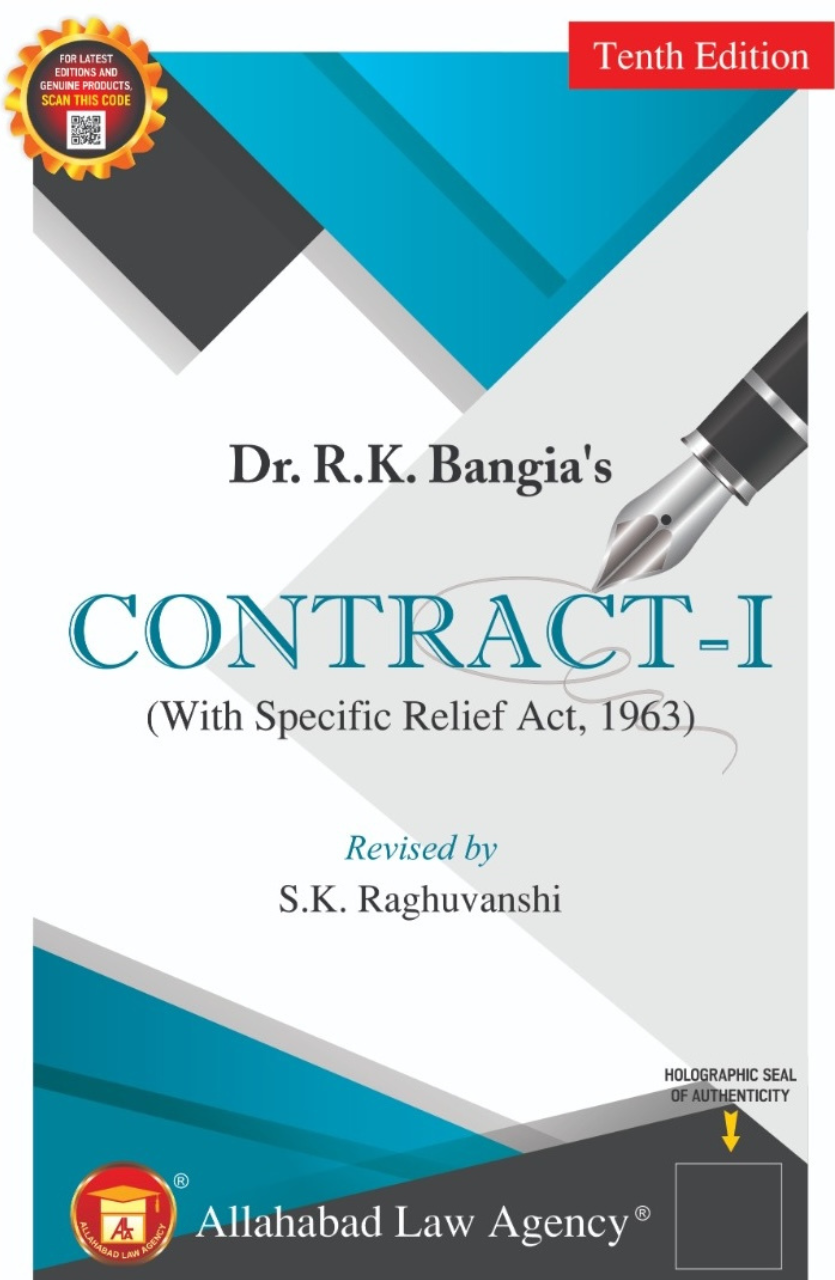

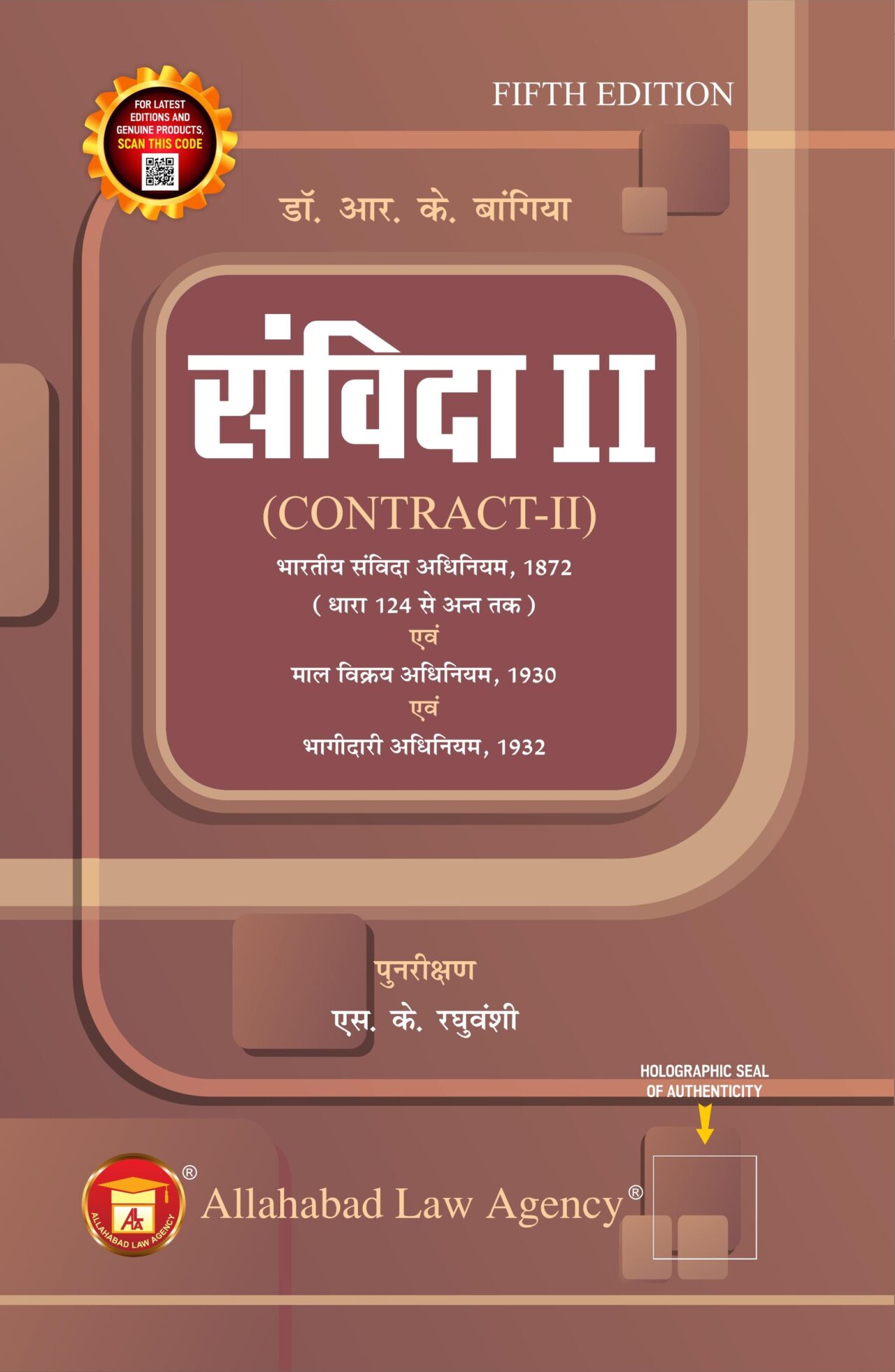
The companion volume to Bangia’s Contract-II and the book that introduces most Indian law students to contract law itself. Contract-I covers the general principles of the Indian Contract Act, 1872 (Sections 1–75) — offer and acceptance, consideration, capacity, free consent, legality of object, void and contingent agreements, discharge of contract, and damages from Hadley v. Baxendale onward — together with the Specific Relief Act, 1963.
The 2026 edition, revised by S.K. Raghuvanshi, retains the case-first Bangia method: every doctrine anchored to its leading authority and restated in exam-ready language. Prescribed reading for first-semester LLB across Indian universities and a standard revision text for judicial services preliminaries.
Genuine copies carry the Allahabad Law Agency holographic seal — 75 years of trusted law publishing.
Where Contract-II covers special contracts, Contract-I is the foundation: Dr. R.K. Bangia’s treatment of the general principles of contract under Sections 1–75 of the Indian Contract Act, 1872, together with the Specific Relief Act, 1963. This 2026 reprint, revised by S.K. Raghuvanshi, walks the first-year student through offer and acceptance, consideration, capacity, free consent (coercion, undue influence, fraud, misrepresentation, mistake), void and voidable agreements, contingent contracts, performance and discharge, and quasi-contracts — each doctrine anchored in the classic cases from Carlill v. Carbolic Smoke Ball Co. to Mohori Bibee.
Generations of Indian law teachers have prescribed Bangia for the first contract paper because it does one thing exceptionally well: it makes the logic of contract law visible to a student reading it for the first time, without sacrificing the precision an examiner expects.
Genuine copies carry the Allahabad Law Agency holographic seal — trusted by law students since 1951.
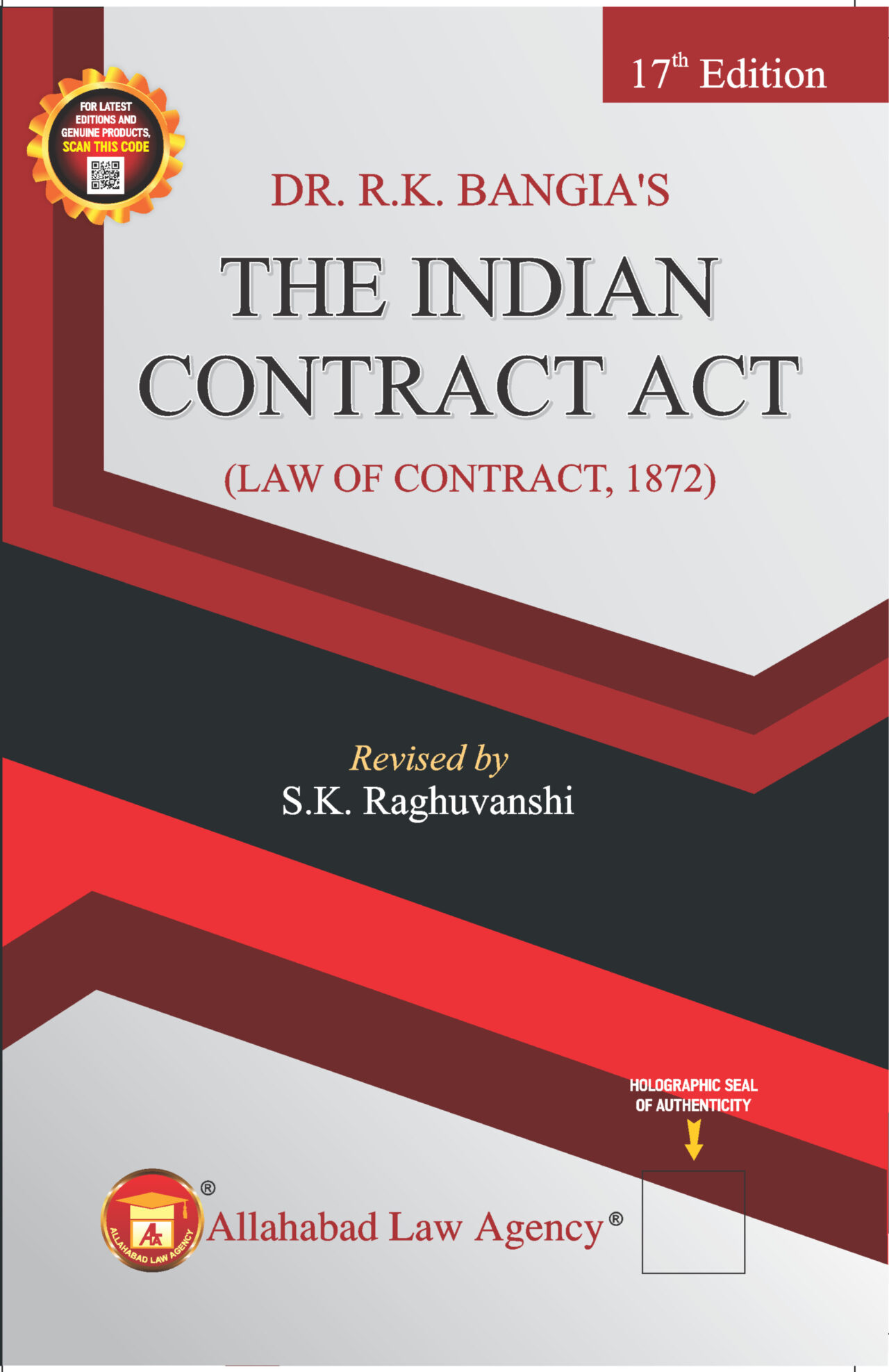
Contract I by Dr. R.K. Bangia is a standard textbook on the general principles of the Indian Contract Act, 1872, widely recommended for first-year LLB and BA LLB students. The book explains the foundations of contract law in a simple, structured style, supported by leading Indian and English case law.
It covers the essentials of a valid contract, including offer and acceptance, consideration, capacity of parties, free consent, legality of object, and the doctrines of mistake, misrepresentation, fraud and coercion. It further deals with void and voidable agreements, contingent and quasi-contracts, performance of contracts, and the consequences of breach along with remedies available to the aggrieved party.
Key highlights:
- Clear treatment of the general principles of the Indian Contract Act, 1872
- Concepts illustrated with relevant case law and examples
- Exam-oriented presentation aligned with university syllabi
- Authored by Dr. R.K. Bangia, a trusted name among law students
This is the latest edition published by Allahabad Law Agency, supplied fresh from the publisher. An essential foundation text for every student beginning the study of contract law.
What’s Inside — Complete Chapter Map
Contract-I covers the general principles of contract in two parts: the Indian Contract Act, 1872 (Sections 1–75) chapter by chapter, and the Specific Relief Act, 1963 in full — with the 2018 Amendments.
Part A — The Indian Contract Act, 1872 (12 Chapters): Formation of Contract (offer and acceptance, communication and revocation, contracts by post, telephone and e-mail, standard form contracts, promissory estoppel) · Consideration (privity of contract and its exceptions, the rule in Pinnel’s case) · Capacity to Contract (the minor’s agreement, persons of unsound mind) · Free Consent (coercion, undue influence, fraud, misrepresentation, mistake) · Legality of Object and Consideration (agreements opposed to public policy) · Void Agreements (restraint of marriage, trade and legal proceedings, uncertain agreements, wagers) · Contingent Contracts · Electronic Contracts (Information Technology Act 2000, e-contracts and the postal rule, leading cases on e-mail contracts and jurisdiction) · Performance of Contract (tender, joint promisors, time as the essence, appropriation of payments) · Discharge of Contract (anticipatory breach, the doctrine of frustration, novation and remission) · Quasi Contracts · Remedies for Breach of Contract (the rule in Hadley v. Baxendale, measure of damages, liquidated damages and penalty, quantum meruit).
Part B — The Specific Relief Act, 1963 (9 Chapters): Introduction and the 2018 Amendments · Definitions · Recovering Possession of Property (Sections 5–8) · Specific Performance of Contracts (Sections 9–25, including substituted performance under Section 20 and infrastructure-project contracts) · Rectification of Instruments · Rescission of Contracts · Cancellation of Instruments · Declaratory Decrees (Section 34) · Preventive Relief and Injunctions (Sections 36–42) — with the full text of the Act as an appendix.
Case law is woven into every chapter in the book’s signature exam-oriented style, making it suitable for 3-year and 5-year LL.B. courses and judicial services preparation alike.
Reviews
There are no reviews yet.