
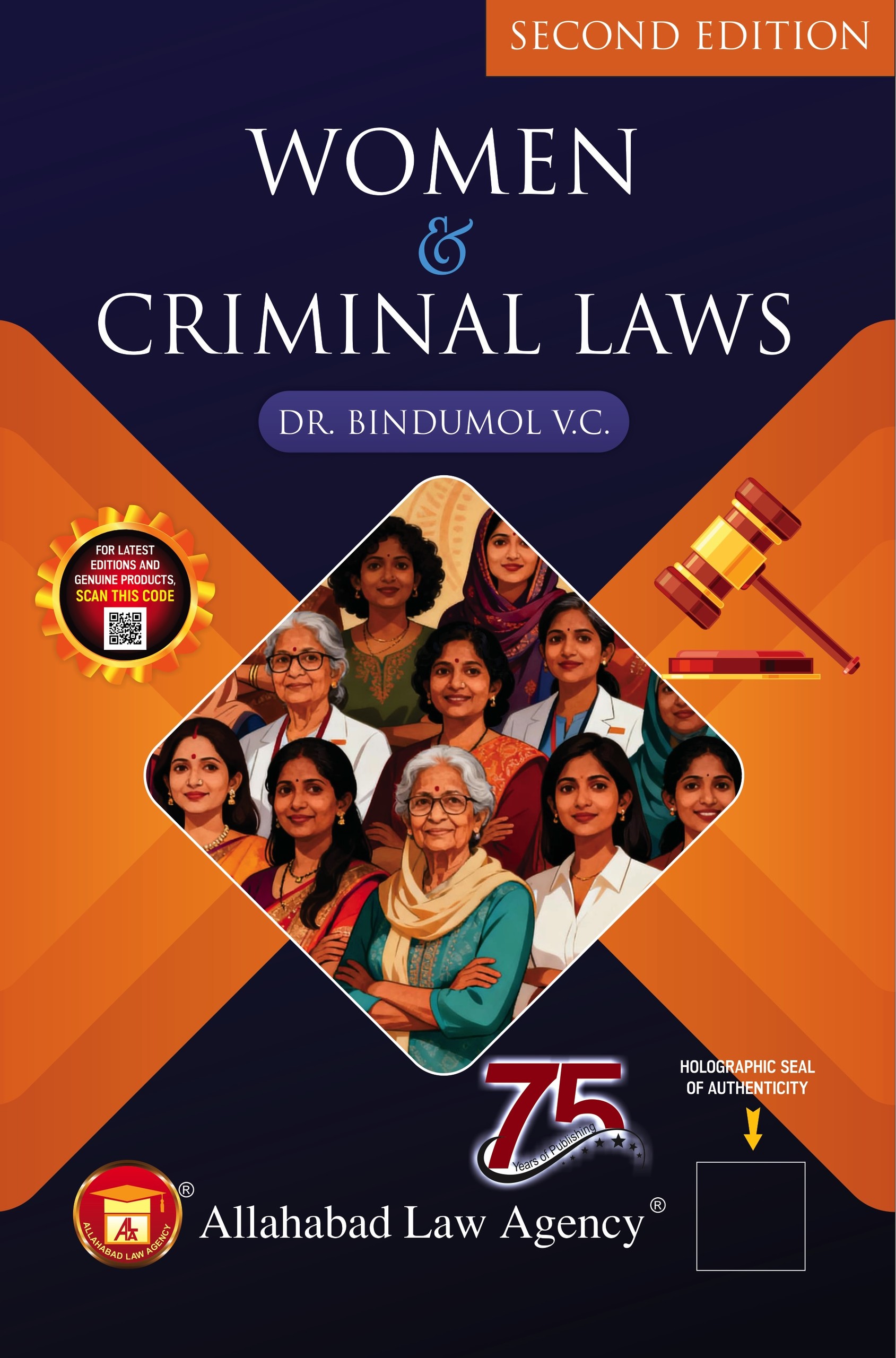

Dr. Bindumol V.C.’s Women & Criminal Laws offers a focused, current treatment of the criminal law protecting women — written afresh against the new criminal codes. It works through the offences against women under the Bharatiya Nyaya Sanhita, 2023, the evolution of rape law through the post-Nirbhaya reforms, cruelty and dowry-related offences, and the special statutes — the Protection of Women from Domestic Violence Act, the sexual-harassment-at-workplace law, and POCSO where it intersects.
The book gives particular attention to the procedural and evidentiary protections now under the BNSS and BSA, and to victim-compensation and support mechanisms. At an accessible price, the 2026 edition is a practical, up-to-date choice for gender-justice electives and a quick reference for practice and competitive preparation.
Allahabad Law Agency — genuine copies carry the holographic seal.
Women & Criminal Law by Dr. Bindumol V.C. is a law textbook published by Allahabad Law Agency.
Written with the needs of law students in mind, it explains the principles and provisions of the subject in a systematic and readable manner, making it a dependable companion for coursework and examination preparation.
Key highlights:
- Systematic, student-friendly treatment of the subject
- Suited to the LL.B. syllabus and competitive examinations
- A trusted Allahabad Law Agency title
What’s Inside — Complete Chapter Map (7 Chapters, 2nd Edition)
Chapter 1 — Women’s Rights in International Law: the International Bill of Human Rights (the Universal Declaration and the two 1966 Covenants) · the Commission on the Status of Women · the Equal Remuneration Convention 1951, the Convention on the Political Rights of Women 1953 and the Convention on the Nationality of Married Women 1957 · CEDAW, 1979 · the four World Conferences on Women from 1975 to Beijing 1995 · UN Women · the Gender Inequality Index, the Millennium Development Goals and the Sustainable Development Goals.
Chapter 2 — Violence against Women, International Instruments: the 1967 Declaration on the Elimination of Discrimination, CEDAW General Recommendation 19, the 1993 Declaration on the Elimination of Violence against Women, the Special Rapporteur, the Optional Protocol, the Violence and Harassment Convention 2019, WHO initiatives, protection for refugee and disabled women, the Trafficking Protocol and General Recommendation No. 38, and the Declaration of Basic Principles of Justice for Victims of Crime.
Chapter 3 — Gender Equality and the Indian Supreme Court: the constitutional provisions specific to women · equality in employment · eve teasing · the recognition of unpaid work · honour killing — the right to marry, khap panchayats, and the preventive, remedial and punitive measures the Court has directed · acid attacks · reproductive rights · adultery · and the exclusion of women from religious worship.
Chapter 4 — Violence in the General Community: the development of the law on offences against women, with the practical questions courts face — the importance and mandatory nature of medical examination, whether police reference is essential, whether a woman’s marital status is relevant, the impermissibility of the two-finger test, and compensation for victims including interim compensation and the Victim Compensation Scheme · trafficking in women and the Immoral Traffic Prevention Act with its definitions, penal provisions and the judicial response · the Indecent Representation of Women (Prohibition) Act, 1986 with case law · cyber crimes against women · outraging modesty · and the Sexual Harassment of Women at Workplace (Prevention, Prohibition and Redressal) Act, 2013 — the international and national framework, the statutory definitions, what constitutes harassment at the workplace, and how a complaint is responded to.
Chapter 5 — Violence in the Family: female foeticide and the Pre-conception and Pre-natal Diagnostic Techniques Act, 1994 chapter by chapter, with case law · domestic violence — the Protection of Women from Domestic Violence Act, 2005, its features and definitions, the duties of Protection Officers and the penalties for default, the reliefs available, and the decided cases · dowry — the Dowry Prohibition Act 1961, dowry death and the meaning of “soon before death” (Section 304B IPC, now Section 80 BNS), cruelty under Section 498A (now Section 85 BNS) and the difference between the two · bigamy under Section 17 of the Hindu Marriage Act · and the Commission of Sati (Prevention) Act, 1987 with its special courts.
Chapter 6 — Government Initiatives: every relevant Law Commission Report from the 42nd (1971) to No. 270 (2017) discussed in turn · the Committee on Reforms of the Criminal Justice System 2003 · the National Commission for Women — constitution and functions · the Justice Verma Committee Report 2013 · the BNS and offences against women · and the central schemes — Beti Bachao Beti Padhao, One Stop Centres, the Women Helpline, Mahila Police Volunteers, the Sakhi Dashboard, Ujjawala, the National Database on Sexual Offenders and the Nirbhaya Fund · with the reports of the Status of Women committees and the NALSA scheme for victims of trafficking.
Chapter 7 — Women-specific Procedures: the procedural protections in criminal law — arrest of a woman, medical examination, bail, in camera proceedings, the bar on capital sentence for a pregnant woman, women as witnesses, search of premises, the victim compensation scheme, and maintenance under Section 125 CrPC (now Section 144 BNSS) · the relevant provisions of the Bharatiya Sakshya Adhiniyam and Bharatiya Nyaya Sanhita, 2023 · registration of marriage · the Uniform Civil Code and gender justice · and protection under specific legislations including the guidelines for female detainees · closing with an Appendix of the women-specific provisions under the BNS.
Reviews
There are no reviews yet.