
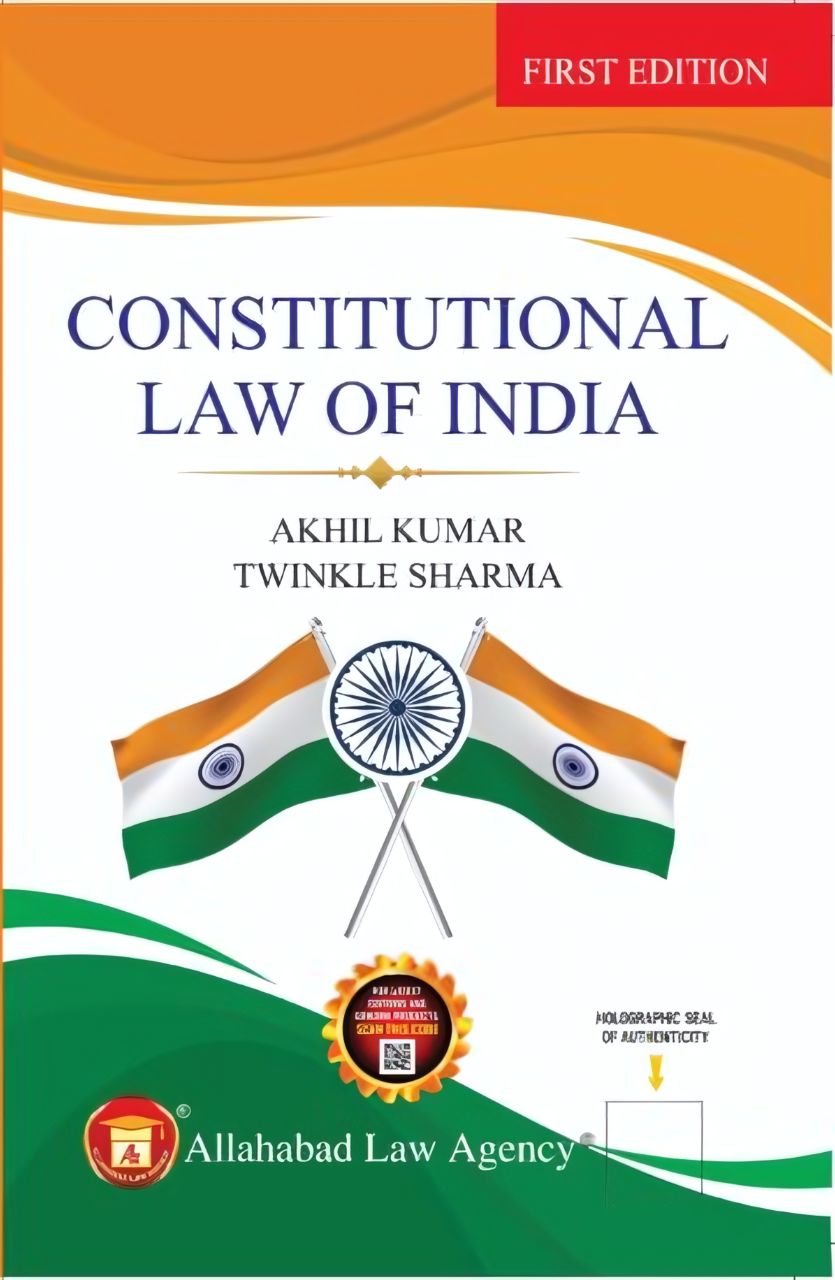

Constitutional Law of India by Akhil Kumar & Twinkle Sharma is a law textbook published by Allahabad Law Agency.
Written with the needs of law students in mind, it explains the principles and provisions of the subject in a systematic and readable manner, making it a dependable companion for coursework and examination preparation.
Key highlights:
- Systematic, student-friendly treatment of the subject
- Suited to the LL.B. syllabus and competitive examinations
- A trusted Allahabad Law Agency title
What’s Inside — Complete Article Map (45 Chapters, Articles 1–395)
A chapter-and-article commentary on the entire Constitution, with a Table of Cases — arranged in the order of the Constitution itself so it can be used alongside the bare text.
Chapters 1–4 — Foundations: constitution, constitutionalism, constitutional law and constitutional government distinguished · the historical background through the eight constitutional experiments from 1858 to the Indian Independence Act 1947 · the making of the Constitution and the Constituent Assembly · the twenty salient features, the sources of the Constitution and its Schedules · the Preamble interpreted phrase by phrase — sovereign, socialist, secular, democratic, republic, justice, liberty, equality and fraternity · the Union and its territory (Articles 1–4), including why India is a union of States and not a federation, and the difference between a State and a Union Territory · and citizenship (Articles 5–11) — the modes of acquiring and losing it, migration from Pakistan, persons of Indian origin abroad, and overseas citizenship.
Chapters 5–14 — Fundamental Rights (Articles 12–35): the definition of “State” under Article 12 and laws inconsistent with fundamental rights under Article 13, with the doctrines of eclipse and waiver · Right to Equality — equality before law (14), prohibition of discrimination (15), equality of opportunity in public employment (16), abolition of untouchability (17) and titles (18) · Right to Freedom — Article 19 clause by clause, freedom of speech and expression with the reasonable restrictions under 19(2), assembly, association, movement, residence and trade · protection in respect of conviction (Article 20) — ex post facto laws, double jeopardy and the prohibition against self-incrimination · Article 21 treated at exceptional length, with more than fifty judicially recognised facets — legal aid, privacy, shelter, livelihood, reputation, medical care, life with human dignity, speedy trial, clean environment, food, water, education, marriage, maternity leave, compensation, rights of victims, telephone tapping, reproductive choice, vaccine policy and more — plus the right to education under Article 21A · protection against arrest and detention (22) · right against exploitation (23–24) · freedom of religion (25–28) · cultural and educational rights and minority institutions (29–30) · and the right to constitutional remedies (32–35).
Chapters 15–16 — Directive Principles and Fundamental Duties: how the Directive Principles differ from Fundamental Rights, the socialistic, Gandhian and liberal-intellectual classification, and every Article from 36 to 51 — social order, equal justice and free legal aid, village panchayats, right to work, maternity relief, living wage, workers’ participation, co-operative societies, the Uniform Civil Code, early childhood care, weaker sections, nutrition and public health, agriculture, environment and forests, monuments, separation of judiciary from executive, and international peace · followed by the Fundamental Duties under Article 51A.
Chapters 17–24 — The organs of government: the Union Executive — the President, his election, impeachment, pardoning power and ordinance-making power, the Vice-President, the Council of Ministers, the Attorney-General, and the Comptroller and Auditor-General (Articles 52–78, 123, 148–151) · Parliament (79–122) — composition of both Houses, sessions, officers, disqualifications, the legislative procedure, money bills, and the whole financial procedure from the annual financial statement to votes on account · the Indian Judiciary (124–147) — appointment of judges and the National Judicial Appointments Commission, the Supreme Court as a court of record, its original, appellate and advisory jurisdiction, special leave under Article 136 and when it is not maintainable, review, Article 141 and the doctrine of precedent with ratio decidendi, obiter dicta and prospective overruling, and the extraordinary power under Article 142 · the State Executive and Governors (154–167, 213) with a comparison of the pardoning powers of the President and the Governor · the State Legislature (168–212) · privileges of Parliament and State Legislatures (105, 194) · the High Courts (214–231) — including Article 226 with cause of action, res judicata, interim relief, and each of the five writs explained · and the subordinate courts (233–237).
Chapters 25–29 — Local and special administration: the Union Territories including the special provisions for Delhi (239–241) · the Panchayats (243–243-O) · the Municipalities (243P–243ZG) with ward, district and metropolitan planning committees · the Co-operative Societies (243ZH–243ZT) · and the Scheduled and Tribal Areas (244–244A).
Chapters 30–34 — Union–State relations and State liability: legislative relations (245–255) with the doctrines of territorial nexus, pith and substance, colourable legislation, harmonious construction, ancillary and implied powers, repugnancy and occupied field, plus the GST provision under Article 246A and the residuary power · administrative relations (256–263), inter-State water disputes and the Inter-State Council · financial relations (264–293) — the distribution of revenues, the GST Council, the Finance Commission, exemptions from taxation and borrowing powers · property, contracts and suits (294–298) · State liability under Articles 299 and 300 · the right to property under Article 300A · and freedom of trade, commerce and intercourse (301–307).
Chapters 35–40 — Services, tribunals, elections and language: services under the Union and the States (308–313) — recruitment, the doctrine of pleasure under Article 310, the safeguards under Article 311, and the All-India Services · the Public Service Commissions (315–323) · tribunals under Articles 323A and 323B · elections (324–329) — the Election Commission’s powers and the bar on judicial interference · special provisions for certain classes (330–342A) — reservation of seats including the new reservation for women in the Lok Sabha and State Assemblies (Articles 330A, 332A, 334A), the National Commissions for Scheduled Castes, Scheduled Tribes and Backward Classes · and official language (343–351).
Chapters 41–45 — Emergency, amendment and transition: the three emergencies — National Emergency (352) with the effect on Articles 19, 358 and 359, President’s Rule (356) and Financial Emergency (360) · miscellaneous provisions including the protection of the President and Governors (361–367) · amendment of the Constitution under Article 368 — the three procedures, the elements of the basic structure, and the important constitutional amendments · the temporary, transitional and special provisions (369–392) including Article 370 and the special provisions for eleven States · and commencement, the authoritative Hindi text and repeals (394–395).

Reviews
There are no reviews yet.