
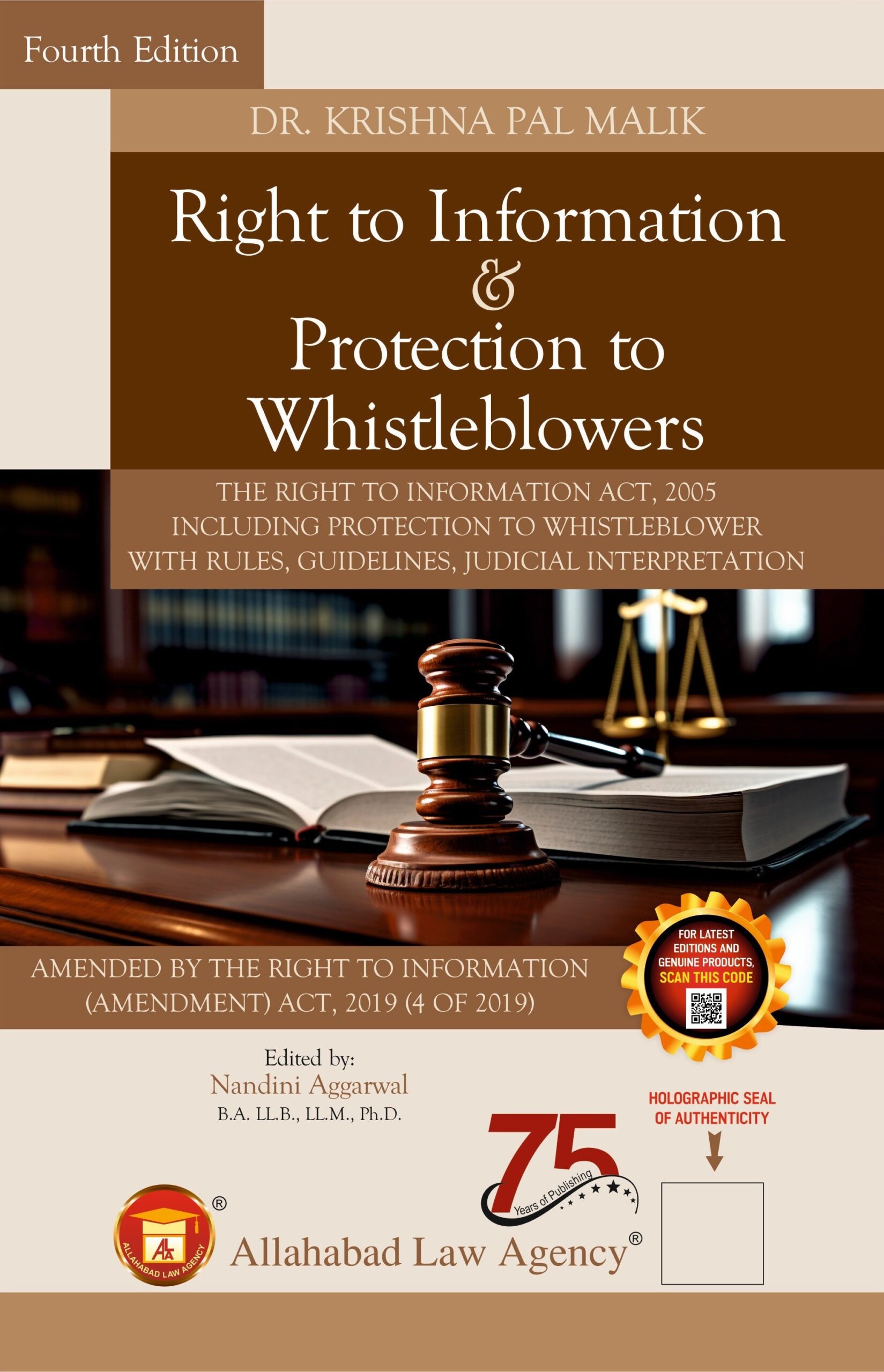
Right to Information & Protection To Whistleblowers by Dr. Krishna Pal Malik is a law textbook published by Allahabad Law Agency.
Written with the needs of law students in mind, it explains the principles and provisions of the subject in a systematic and readable manner, making it a dependable companion for coursework and examination preparation.
Key highlights:
- Systematic, student-friendly treatment of the subject
- Suited to the LL.B. syllabus and competitive examinations
- A trusted Allahabad Law Agency title
What’s Inside — Complete Chapter Map (14 Chapters + 9 Annexures)
Chapters 1–2 — Foundations: the right to know and the international approach to freedom of information, the position in developed democracies, disclosure of government information in India, the historical background and enactment of the Right to Information Act, 2005, its objects, purpose and features, and why it requires a purposive rule of interpretation · the constitutional perspective — the right to know as an integral part of freedom of speech traced through the judicial approach before and after 1975, whether it forms part of Article 21, the right to privacy, the scope of “State” under Article 12, and writ jurisdiction under Articles 226/227.
Chapters 3–6 — The Act in operation: Right to Information — applicability, the definition of “information” (record, documents, opinions, data in electronic form), who may claim it, information “held by or under the control of” a public authority, third-party information, modes of access, proactive disclosure, the overriding effect of the Act and the bar on civil courts · Public Authorities — the definition and classification (constitutional instrumentalities, statutory bodies, notified authorities, bodies substantially financed by government), what “controlled” and “substantially financed” mean, substantially financed NGOs, and the bodies held not to be public authorities including cooperative societies, unaided colleges, private institutions and temples · Obligations of Public Authorities — computerised records, suo motu disclosure, publication of policies and reasons for decisions, designation of PIOs, APIOs and First Appellate Authorities · Procedure for Access — how to apply, fees and BPL exemption, disposal of requests, time limits, the third-party procedure under Section 11 and the hierarchy under the Act.
Chapter 7 — Information Exempted from Disclosure: each ground under Section 8 in turn — sovereignty and integrity, security and economic interests, foreign relations, incitement of an offence, contempt of court, breach of privilege, trade secrets and intellectual property, fiduciary relationships (including the examiner-examinee question), foreign-government information, danger to life or safety, investigation of offences, Cabinet papers, and personal information with the test of privacy under Section 8(1)(j) — closing with copyright and the organisations excluded from the Act.
Chapters 8–9 — The Commissions: constitution, qualification, tenure, salaries and removal of the Central Information Commission and the State Information Commissions, their powers, functions and autonomy, and the demarcation between administrative and quasi-judicial orders · complaints and inquiries under Section 18, the first appeal and the second appeal to the Commission with the full procedure, compensation, and the distinction between Sections 18 and 19 · penalties and recommendations for disciplinary action, with the procedure at a glance.
Chapters 10–13 — Related regimes: Official Secrecy — the Official Secrets Act, spying, wrongful communication and how the Act is read alongside the RTI Act · Right to Privacy versus Right to Information — the historical development of privacy in India (surveillance, telephone tapping, medical privacy), international commitments, and where the two rights conflict · RTI and Good Governance — its evaluation as a tool of governance and as an instrument against corruption · Protection to Whistleblowers — who is a whistleblower, internal and external, and the protection the courts have extended.
Chapter 14 — Landmark decisions up to 2025, twenty cases discussed individually. Nine annexures carry the Right to Information Act, 2005, the RTI Rules 2012, the CIC (Management) Regulations 2007, the Rajasthan and Gujarat RTI Rules, the updated 2013 guidelines, the Official Secrets Act, 1923, the Whistle Blowers Protection Act, 2014 and the 2015 Amendment Bill.



Reviews
There are no reviews yet.